
Invisible solid objects
Eduardo Boaventura
By accepting the challenge of writing about TONM’s work, the first difficulty, as an expert on his work – vast, fruitful, multiple, dynamic, etc., etc., etc – is: Where to start? I’ve decided to present my thoughts about his last works, object of this present exhibition.
Tonm is not only a plastic artist in the simplest meaning of the term. He is, mainly, a creator of concepts, visual and sensorial experiences of the most complex kinds and with the use of the most unexpected materials. Visiting the work of this artist is coming across an endless ability to create, recreate and transcend.
The amplitude of his work owes very little to his more than three decades of creation and a lot to the qualitative peculiarities of what he creates and how he creates.
Sticking to the present moment, can we name these spectacular works invisible solid objects? Yes, I believe this metaphor, to begin with, is useful.
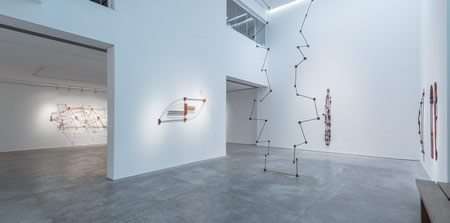
The new sculptures by Tonm, completely open to light and that allow to see through them integrally, transforming spaces into shapes that merge and transform themselves into floating compositions, transporting the spectator to a transcendent dialogue, to materiality, as a new way to see the composition in three dimensions, something to which only now technology has caught up - tridimensional images through 3D projection – has been, for a long time, the feeling that the hollow solids transmit, only noticeable to those who follow the lines in the construction of the solid. They are parallel or radiant lines that form geometrical figures, squares, triangles, trapezes, rectangles, one side overlaps the other, which on its turn overlaps the superior and inferior part, they are points that unite them and unite us to the limited space, restrained – and sometimes released – in fine lines and wood shapes, all of them worked in shades and possibilities that only woods provide in this way, rich in details and textures.
Some woods for their rarity and scarcity are pieces of art themselves. Diving in the beauty of Bahia rosewood and finding amid that entanglement of black fibers, glimmers of a bright red, of striking expression, that surprise us and transport us again through their unusual constructions, since they are not hermetic – true expression of nature unveiled in the fibers – and unveil large solid shapes through the light and observation of an attentive eye.
The balanced shapes are integrally harmonized by the construction of the sculptural spaces in each piece, built with unique mastery, between parallel lines, when Tonm handles the wood, with his more than thirty year experience, producing art uninterruptedly, especially sculptures with the most diverse materials – rocks, woods, metal, pastes, cardboard.
The elements that compose the present group of sculptures, to which I would like to keep referring as INVISIBLE SOLID OBJECTS to maintain the initial metaphor and that still seems to me as the closest description of what the senses capture, denote a true tribe of personalized figures that emerge to the spectator’s eye and recognize themselves from one object to the other as milestones that, suddenly become familiar to those who already know the artist’s work. For those who don’t know his work, a pleasant perception springs immediately that it’s about analytic studies of geometrical shapes, taken from solid contents that became abstract to the senses, to the enchantment of the eye through the talented hands of this artist. Thus, from wood rods shapes are translated which are restrained – or freed depending on the eye that captures them – in lines that suggest energetic tensions, a constructive way to express form, educating the observer’s eye, producing resonances of ampler shapes, linear illusions of a complex mode.
Tonm expresses in his art in a unique, breathtaking and singular way, the lessons of the great universal masters, he’s capable of turning a simple object – wood, rock, metal, etc – into an expression of the profusion of life itself.
That’s what Kandinski says: “Form is the outward expression of this inner meaning”.
That’s what Paul Klee confirms: “Art does not reproduce the visible but makes visible’.
This has been, in these thirty years and with even greater mastery at this moment, the work of Josilton Tonm.