
Daniel Feingold: Structure and mismatch
Tiago Mesquita
Daniel Feingold creates color fields as light fields. In this exhibition, he covers the monochromatic surface with very simple shapes: bands that overlap or juxtapose one another. Reunited, they create a rhythmic pattern that reorganizes the surface. This structuring attempt alone could be interesting in itself. The work, however, is more than that.
The effort to reorganize the surface stumbles on the materiality of the paint, the overlapping of patterns, their mismatches, interstices between the shapes. As far as the artist organizes the patterns, covers the surface, his gesture embodies the mushy materiality of the enamel, its drips and wrinkles. Feingold’s painting is not only about putting the colors in order on a determined plan anymore, but also about the fragility of any project. The way this project happens when it takes shape. That’s why it’s an action painting.
Different from works exhibited before, here Feingold doesn’t use diagonal lines, or curves. So, there’s no illusion of a space projected on the canvas, a space that ironically opens up to the depth. The paint acts as tapestry, in points and lines that try to cover the fabric, without leaving empty spaces, in a decorative way, in the Matisse sense of the two-dimensional use of the space.
Life remains hard, however. As surefire as the artist’s gesture might be, it doesn’t seek to “correct” the irregularities of the light and the matter. He accepts and works with them. This is the construction: keeping paint’s way, even if the material doesn’t want it. That’s why the bands painted by Feingold seem slightly irregular, mismatched, the artist builds an attempt to occupy the surface that is not so detailed, so appeased. It avoids the appeasing of the painting.
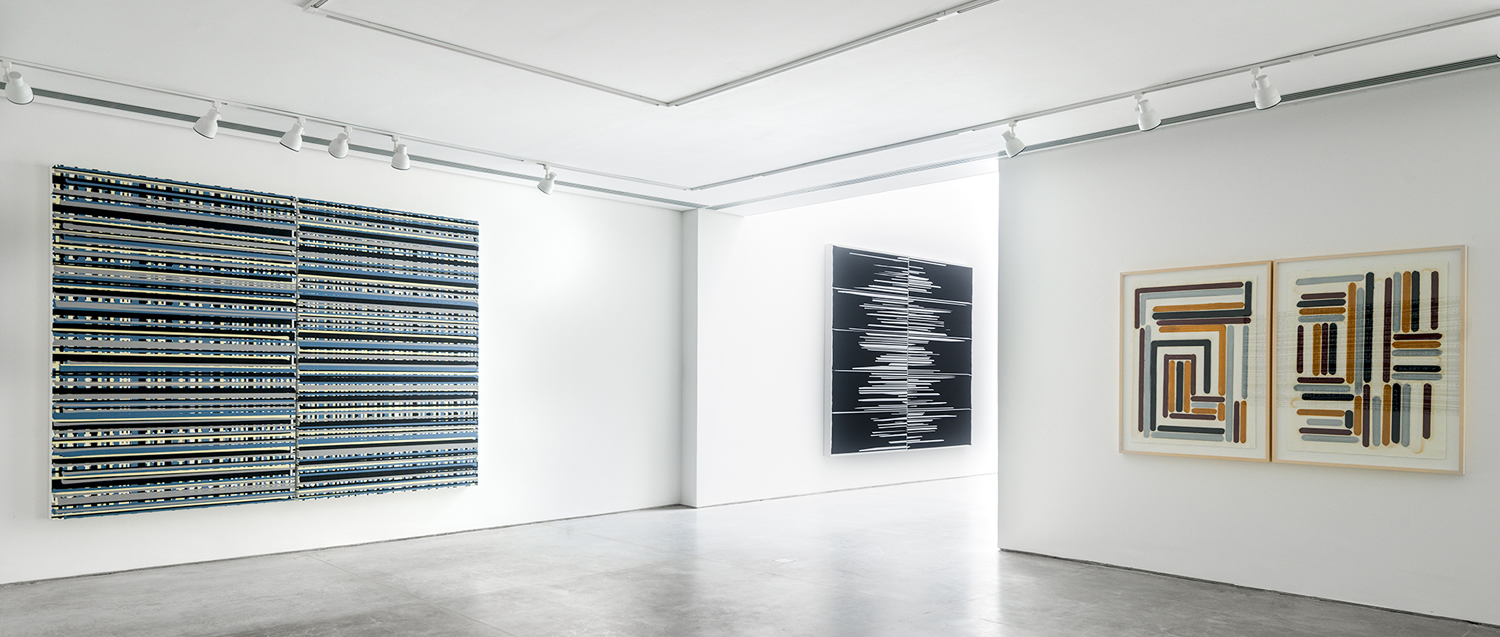
In the painting series Yahweh, white bristles cut the pitch-black of the black stain that fills almost the entire surface. The artist seems to draw upon the contrast between black and white to suggest, through the title, the metaphor of the creation. The image can be associated to the moment when light shone. From the center to the edges, the white shapes operate as if they shattered the cancellation of the sight of the black stain. The shapes split darkness and allow us to see.
However, the way the shapes shine doesn’t seem very promising. The bands that part from the center to the left don’t necessarily correspond to the ones that stretch from the center to the right. Most of them don’t reach the margin of the painting, or the margin of the black. They let a piece of light in, as if they cracked a bulkhead.
The contrasts are enough to make us realize the asymmetrical discrepancies between the two juxtaposed canvases. The chassis of one of them has a wider gauge that the other’s, and we have a glimpse of how difficult it is for the representation to give any kind of more harmonious unit between one part and the other. While it deals with the difficulty of occupying the space with a regular shape, the work establishes a complex composition, with irregular and peculiar rhythms.
The series Estruturas intensifies the spatial complexity. In the work, the horizontal bands are rectilinear, have several colors and cover other innumerous grid plans, made with the same colors, of vertical and horizontal lines. It’s not about forming a grid, but covering the patterns that existed before and trying to give them some meaning. That’s why the painting reminds us of the urban interventions where a city is covered by another and the past structures remain as ruin or vestige. What is left is a complex use of the space that coexists with the remains of other uses.
Here, the vertical and horizontal bands behind the more apparent bands have a residual presence. In Estrutura #18 (2016), we see it through the interstices of the horizontal elements or in cracked parts, when the artist’s gesture doesn’t cover all the extension of the canvas. After all, the horizontal grid is also brittle, full of white paint marks that link blue, grey, red bands, like bridges. Although they resemble patterns, straightforward gestures throughout the canvas, the bands are brittle, incomplete.
The incomplete character is amplified in the paintings with juxtaposed canvases. Works where the discrepancies between the right and left patterns amplify the impossibility of attributing a unit without contradicting the work. In the end, it’s this complexity that also guarantees the complexity of the image. In his work, the experience happens when the schematic rationality falters.