
Paulo Whitaker
Eva-Maria Schumann Bacia, Freiburg
About Paulo Whitaker´s paintings
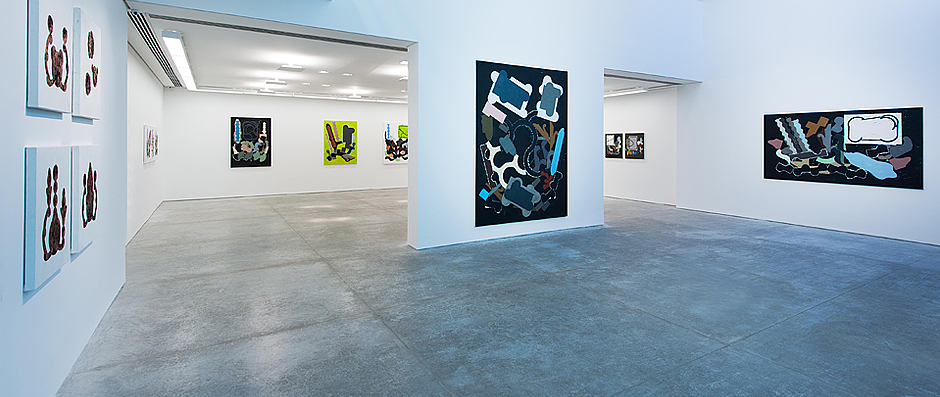
"Art is an abstraction; derive this abstraction from nature while dreaming before it, but think more of creating than of actual result" (Paul Gauguin, 1888) In Paulo Whitaker´s work, both in the paintings and in his drawings, we can notice a work pursued with insistent and constant seriousness and the same impulse and impetus is always evident: the search determines his action. In all his works, this search may be recognized and identified as process. A process that becomes evident through numerous layers, occasionally diaphanous and translucent of the controlled painting, composed carefully to exhaustion, in the same way as in his works on paper, which are characterized by concrete gesture traces and abbreviations quickly outlined. The shapes find their configuration in the white of the paper or on the monochromatic color surface, in extension and number purposefully reduced. Paulo Whitaker doesn?t completely give himself away to the gestures to which he surrenders and, as he never loses control over these gestures, in his case we could only talk about a ?controlled spontaneity?.
His work can?t be placed in the ambit of the abstract Expressionism or in the informal tradition, nor in the so called field painting; however, his work would be unthinkable if we didn?t take into consideration any of these trends. Paulo Whitaker searches for the shape and, inclusively in the reduction of the pictorial means; his attention is focused mainly on one thing: the shape.
With the creation of the shape and its subsequent correction through the act of daubing, painting over, making emerge a variant in another point, with the denial of the shape through rubbing and letting it disappear completely, Whitaker questions tenaciously and constantly the issue of what remains until today to be painted. The artist seems to isolate this questioning based on a reduced repertoire of shapes, a repertoire questioned throughout the years, slowly extended and that, with variations, always emerges as a Leitmotiv and that constantly and freshly narrates a story like the one of animated beings that suffer ? sometimes they?re stronger, sometimes weaker, they speak louder or are more silent, disappear and appear again. However, Whitaker doesn?t wander to the literary, and the level of abstraction in his paintings remains noticeable.
Because, although in some shapes the associations are adjusted to the concrete, his image inventions are never conceived in a tridimensional way, remaining tied to the state of a plane and abstract abbreviation. It?s due to the fact that the artist takes into consideration in his work the natural two-dimensional aspect of the support?s background, besides transferring as determinant factor the height and width coordinates for the pictorial language of the painting itself: neither perspective, nor light and shadow model a space of depth. Only the line and the mass are determinant for his pictorial language. Paulo Whitaker develops a compact code of signs that present a formal cohesion among themselves. In this way, there?s a cornucopia of meanings, although in such a way that all of them, without exception, return as a figure of the pictorial world imagined by the artist. Thus, Paulo Whitaker?s works are as if ?interlaced? by an image language that remains constantly alive in new creations, similar to the process that occurs with the spoken language, which is kept alive through neologisms. The seriousness with which Paulo Whitaker faces the questioning that insists in emerging, that is, ?what is possible to express through painting?? allows the research and the invention to blend in a single thing: a search for lasting traces that refer to ?what is long known?, but, at the same time, that doesn?t refrain from investigating something new.
Differently from Gauguin, who used nature as starting point for inspiration, Whitaker involves his pictorial language with the history of Art itself. It?s history that forms the transparency on which he reflects. Those who contemplate a work by the artist and don?t bear in mind that the entire development of the history of Art should be included as an essential assumption will certainly feel lost.
Paulo Whitaker places sense elements in such an abrupt way, one next to the other, elaborates zones with things that belong to contexts so distant from one another that the eye is forced to concentrate in details. Forcing punctual perspectives and, in this way, a huge flexibility, he manages to tie meanings: the correspondences are called to arms, mobilize against hierarchic organizations. Whitaker creates a semantic thread of relations. Isolated aspects let themselves associate with others; from parataxis emerge knots of meaning, there are always overlaps and empty spaces. To Whitaker, the important thing is to present relations.
His action is sensorial and intellectual at the same time: the dynamic of the paintbrush guided by the hand itself or the graphite?s line are corrected through the intervention, the evaluation of the intellect that doesn?t lose sight of the composition, stopped by harnesses. Paulo Whitaker?s painting is totally anchored in the present; he contributes to the environment, so explored today, of the painting with the auto referring exploration of the work process and the creation of shapes.
Like John Cage, Whitaker is very far from tying a metaphysic statement to his works. Although in his paintings he only approaches the figuration in an allusive way, without intending to enter deeply in the central issue of representation, he?s viewed by some people as someone who, in the ambit of abstract art moves towards figuration. The ?concretes?, however, continue to consider him an abstract artist. Which is, therefore, his position? One more question: Do the shapes found, a quick sketch on a monochromatic surface, in a way suggest that at this point the American painting called field painting meets the European Romanticism? A mistake because, with his work, Paulo Whitaker doesn?t supply a contribution to the metaphysics, and it?s necessary to emphasize again that his painting appears around the painting by its own will. To Whitaker, what matters is the incessant search for something that can only be expressed and researched through painting.
Eva-Maria Schumann Bacia, Freiburg