
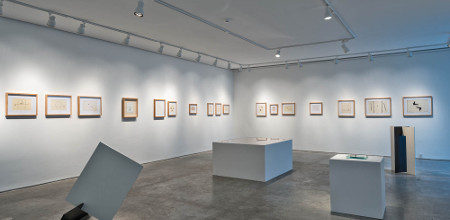
Almandrade by Marc Pottier
Marc Pottier
The 3rd Bahia Biennial in 2014 was to me a privileged occasion when I discovered Almandrade’s work. Various aspects of his work were presented. The first proposal was an incredible three-dimensional exercise, going from a big sculpture located at UFBA’s Ondina Campus to amazing mockups in small scale at São Bento Convent: colorful compositions that dialogue with the landscape and the buildings or the convent’s volumes, evoking, in an interesting paradox, the rigor of Franz Weissmann or Amilcar de Castro’s shapes, but also a labyrinth by Hélio Oiticica (as we can see in Inhotim). We could also think about Mondrian, with his refined composition-landscapes, made of horizontal and vertical lines. The different planes that interpenetrate offer visitors a balanced game of colorful geometrical shapes aired, in some situations, by windows of shade and light of constructive and minimalist tradition. As Francisco Antônio Zorzo notes, Almandrade “intentionally keeps a distance from baroque, expressionism and other sensual like trends that are recurrent in Bahian and Brazilian art”. Actually, by discovering this tentacular work, the Biennial presented also numerous drawings and poems, thus the artistic references fade a little and make us travel away from Bahia.
“Painting is concrete and not abstract because nothing is more concrete, more real than a line, a color, a surface”, claimed Theo Van Doesburg and the members of the Concrete Art group formed in 1930, in Paris. They preached a non-figurative art form, having broken with all other processes of abstraction of the real world and favoring the direct and rational manipulation of the art work’s plastic components. Almandrade belongs to the post-constructivism era, incorporating the contribution of Brazilian neo-concretism and also the one of Concrete Poetry, redistributing postulates of Concrete Art for a precursor dialogue with Conceptual Art.
But this participation in Bahia Biennial was only a small sample, an appetizer before sitting at the table for those who want to discover who Almandrade is and the different faces of his masterful work.
At least we can say is that 45 years ago Almandrade, born in 1953, architect, showed that he had another rabbit to pull out his hat. Let yourselves be impressed! Theorist, journalist, art teacher in Salvador, Bahia…As artist, his work juggles with sculptures and installations, engravings and drawings. Since the 1980s, he’s the author of various book and collections of poems. Before that, in 1974, he edited the magazine “Semiótica”*.
He leads us, in his manner, invoking constructivism, minimalism, lettrism and conceptualism. This is, no doubt, the reason why his creation reaches higher notes with his visual poems. If his originally from Bahia, his work has a universal vocation. As Oscar Wilde said: “the world is my oyster”, Almandade would love to say it too. He soon invented his own signature in which the influence of Hélio Oiticica or Lygia Pape’s aesthetic stand out, or of his dear friend Wlademir Dias Pino and Ferreira Gullar in the poetry world.
Bataille, Jorge Luis Borges, Lautréamont, Sade, Bachelard, Machado de Assis, Italo Calvino, among others, are his references. In 1973, he met Augusto de Campos (one of the founders of the Concrete Poetry movement in Brazil, as well as of the literary magazine Noigandres), and was also friends with the famous poet, translator, critic and essayist Décio Pignatari. “The poetic language differs from the language we use for daily communication. Each poet explores the language in the search for an unexpected event, a singular experience”, said Pignatari.
It’s necessary to remember that Concrete Poetry rises simultaneously in different countries in the 1950s, as a vanguard movement. It’s about an art loaded with experimentalist trends, which emerges from new forms of text organization. This poetic movement distances itself from the conventional structures. It formed a new poetic paradigm, influenced by Dadaism, Modernism and Futurism, as well as by great thinkers and poets such as Stéphane Mallarmé (the greatest reference of this movement), Apollinaire, Lewis Carroll, Alfred Jarry, Ezra Pound, James Joyce... Concretism was publically launched in Brazil at the National Exhibition of Concrete Art, between December 1956 (São Paulo) and February 1957 (Rio de Janeiro). This new form of poetry, based on a traditional visual poetic, is defined as “an element of the communication theory and semiotic”. The phrase is disorganized, the discourse broken with its own disordered words, aiming at creating new relations between syntactic elements, searching to break with its own syntax. The graphic space takes on another role in the poem. Almandrade feels like a graphic artist talking to literature and wants to state that poetry is part of the visual arts too.
Under the strong influence of concrete poetry, the artist’s own name becomes his first work: “ Antônio Luiz M. Andrade, whose initials form A.L.M.A, therefore the composite “Almandrade”. But this is the country of the “Andrades”: Mário de Andrade, Oswald de Andrade, Carlos Drummond de Andrade...I point out that “Almandrade” resembles also “Sousândrade”. Thus, we have a reunion of names of poets marked by irreverence, boldness and, especially, by the radicalism of invention”, comments professor Jayro Luna.
We could say that Almandrade invented a new form of “Brazilian Haiku”, reduced to its simplest expression. The 17 syllables in three verses are summarized in a single image in which graphics plays with the letters. This concise, active and live form invites us to find out what is occult; it proposes a visual performance that compels the observer to cross the information, discover the paced sounds of their reading in order to appreciate the work in full. This minimal is much more complex that it seems at first sight, and forces the search for poetic keys to the different angles addressed. His repertoire is generally limited to some signs and words. The artist takes the language to its limits and gives himself the right to transform the order and meaning of things. It’s important for him to invent other relations with the world and his daily life. “The great visual wealth allied to the semantics of the proposal make Almandrade one of the most creative language workers. “A builder.”, Gutemberg Cruz. Almandrade participated also in the poetry/process movement, form of extreme visual expression, without theory, where the words of the poem could disappear before a simple signal.
“The poet’s hand invents and relates images, mobilizes the thoughts of those who look in search for a history, or better, of a pre-history of the graphic arts and its poetic. A performance of the visuality that travels in time and demands from us a provocative contemplation.”, writes the artist.
Almandrade is also part of the Etsedron group. We should remember that in the 1970s the Environmental Art emerges, where the art objects were integrated to daily life. In Brazil, Frans Krajcberg and the Etsedron Group worked with interventions in landscapes aggregating plastic arts, music, dance, photography, literature and cinema. Works that integrated nature and the social reality of the Brazilian people strengthened the bonds between art and life.
Sculpture, assemblage made with simple everyday objects, drawings, engravings; all his works are part of a subtle base of humor, from where rises all pleasure. He makes us belong to an intelligent world where it’s possible to get along with reality. His strict graphic vocabulary, with an economy of means, the shape games, sometimes of chromatic oppositions, propose minimum, subtle, forgery free works.
Almandrade plays with the full and the empty and also with his texts that place the natural space in discussion, compelling us to search for the understanding of his enigmas. From his mind Ready Made, of signs and simple words, he forces us to mentally remake the work’s construction process, which might lead to the frustration imposed by doubt. His silent and synthetic works under essential shapes are visual aphorisms that lead to new perceptions and conceptions.
Uma parte de mim
é todo mundo:
outra parte é ninguém:
fundo sem fundo.
uma parte de mim
é multidão:
outra parte estranheza
e solidão.
Uma parte de mim
pesa, pondera:
outra parte
delira.
Uma parte de mim
é permanente:
outra parte
se sabe de repente.
Uma parte de mim
é só vertigem:
outra parte,
linguagem.
Traduzir-se uma parte
na outra parte
- que é uma questão
de vida ou morte -
será arte?
Ferreira Gullar
(*) The magazine "Semiótica" had only one issue, in July 1974; we were students without any pretensions, the other ones that were part of the group dedicated themselves to other activities, they didn’t intend to be artists or poets. It was an experience in a provincial city that didn’t know anything about vanguard and refused contemporaneity, we didn’t have any support, it was a publication with its mistakes.