
Estrelas flamejantes em manhã de sol
Marcelo Campos
"The sunlight came into the room with the peacefulness one remembers from rooms in one's early childhood – a sunlight encountered later only in one's dreams." James Baldwin
Sunny days cause an illusory feeling of clarity and happiness. The mornings seem to announce the now and the afterwards. However, the memory and the what-may-come are blended. It's possible to wake up with the stars of the previous night still in the sky. Such image brushes the encounter of time periods supposedly opposite, night and day, and stir up the imagination of poets and the exhibition Estrelas flamejantes em manhãs de sol. Tiago Sant’Ana shares the aspirations of the delirious, "and what if we woke up and saw all the stars of the night sky together with the morning sun?" Based on this fictional restlessness proposed by James Baldwin, American writer born in Harlem, we see the common features between the four main paintings presented in this exhibition, created under a certain dreamlike and fable-like context.
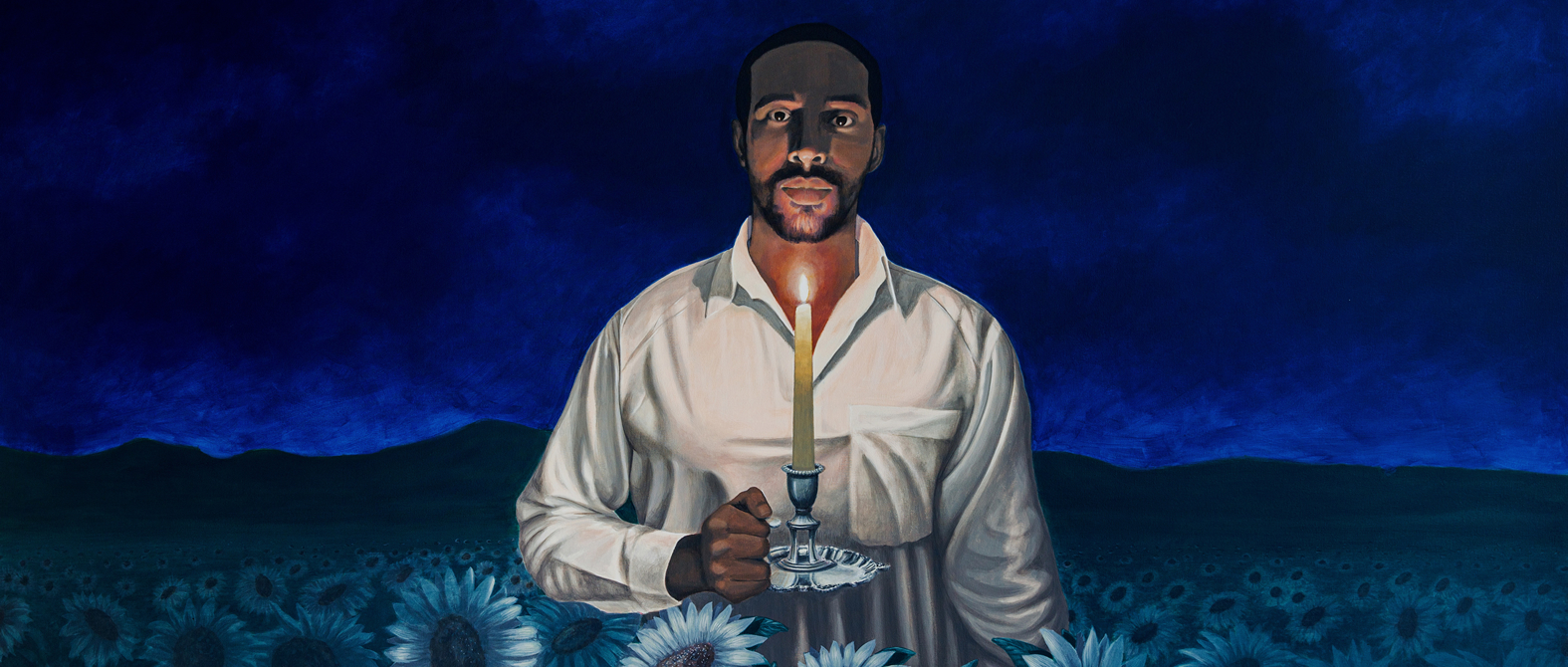
Tiago Sant’Ana paints bodies and faces that are lit in a theatrical way, exhibiting the sources of light that sometimes come from the sun, sometimes from the moon or even from a candle. Júlio Cesar Sanches, Ivã Coelho and the artist himself, in a self-portrait, appear involved in an allegoric atmosphere. In the Baroque painting of the 1700s, there was the same recurrent gesture of inserting light sources in an artificial, allegoric way, exhibited, for the first time, without the dissimulation of the natural light of the Renaissance paintings. With this, the contrast of the chiaroscuro started to give characters a dramatic clearness, overexposed, as in the use of flash under the sunlight.
In the four main paintings of the exhibition, Tiago Sant’Ana gets into amplified scales. He creates researches around black masculinities and, here, we understand the adherence to James Baldwin’s writings. The chiaroscuro, previously a recurrent concept mentioned by the history of art, now acquires ethnical connotations. In Tiago Sant’ana's current production, started during the pandemic, the dreamlike imagery, referring to the horizon of the impossible is associated, in another way, to the recent expectations of the art system regarding the production of Afro-descendent artists. What is expected, what is offered? The artist, thus, mentions in his digressions James Baldwin's epigraph, present in the book "The Fire Next Time". Baldwin when imagining waking up to a starry sky, projects himself in awe, terrorized because such fact would unbalance the rationality present in nature's laws. On the other hand, the author takes on the metaphor and reflects: "the black man has functioned in the white man's world as a fixed star, as an immovable pillar: and as he moves out of his place, heaven and earth are shaken to their foundations." With this, the possibility of Tiago Sant’Ana producing the symbolic, the fable-like, doesn't take him far from a contemporary line of thought, even in telluric images were the expectation of an art system created by the works of black men doesn't necessarily match their mobility since, as stated by Baldwin, the black man is imagined as "an immovable pillar". But if he moves "heaven and earth are shaken to their foundations." Tiago Sant’Ana watches out for the issues that guide his production. Through one of his main paths, we have the body, the body that performs, exhibits itself, presents itself and faces the scene. The artist starts his production through his performance experiences and his work with groups and collectives. There was, then, at the time, interest in democratizing art, in performing in public places, often disconnected from the art system. On the other hand, Sant’Ana participated in regional shows, expanding the use of other languages, such as photography and video. In this way, a need of a greater control over the results of the image emerged, what in experimental performances didn't always happen. The use of photography and video place the artist directing the scene and the work acquires control, theatricality and drama.
Estrelas flamejantes em manhãs de sol presents a new research by Tiago Sant’Ana in which the control over the result is maintained. The precise method itself of executing the paintings, which we see in the drawings and sketches also exhibited, defining color areas, graphic stains, keeping a certain geometrization, even when producing skies and clouds, marks a singularity, especially in the more precise geometrization of volumes. The color gradients barely allow us to get a glimpse of the division between the colors; what could place the production in an almost photographic realism, actually retreats by shedding even more sunlight on clear places, the whiteness of the clothes, for example, that almost approach the sunny atmosphere of Edward Hooper and Eric Fischl. In contrast, Sant’Ana chooses pure, overexposed whites. And, here, we return to the guiding element of the exhibition: the sun.
In the painting that names the show, Júlio César Sanches' character, dressed in a light pink suit, holds a sun mask close to his face. The artist explains that the color "has to do with the shades that the sky so often acquires in the twilight. So, again this is the investment in something that hasn't happened yet, but comes close to happening (it's not completely day or night)". Behind the standing man a sky in color gradient incites us to imagine the dawn or the twilight. In the words of the artist: "the sun has a curious story because it's a variation of a sculpture of the Sun King, Louis XIV. Here the mask acquires African features, from the lips, nose to the braided hair." Sant’Ana refers to this character of the history of the nobility who, in a way, demonstrated for the first time the power of the image beyond what it indicates. The symbol that surpasses the index, Louis XIV, whose portraits date from when he was "a baby in swaddling clothes" to when he was "an old man in a wheelchair", as Peter Burke observed. The most famous portrait of Louis XIV, painted around 1700 by Hyacinthe Rigaud exploits the ornaments, details, brocades and fabrics. The public image, then, distances itself from the private and personal, or even from the self-image. On the contrary, it was built as a metaphoric image projected in texts, poems and plays, court rituals, as a show according to Peter Burke's analysis in a text dedicated, exclusively, to the Sun King. Burke also remembers a concept by Clifford Geertz, the "theater state" when reflecting on the king's portraits. Here, we can say that in Tiago Sant’Ana's paintings the characters appear in "theater state", acting. But astral connections are created, in contact with other worlds, other cosmovisions, or better, with imagined worlds In the allegory created by Tiago Sant’Ana, sky and stars are also curtains and tiles, "patterns", word curiously associated to what is projected of a personality, from a subject. The pattern that concerns Estrelas flamejantes deepens the allegoric comprehension, racializing it. Men of elegant figures, barefoot, make us think of the artist's researches about Brazil's slave trading past. "Here there is a connection with all my research about footwear as this precarious symbol of black citizenship - which was never fully reached in Brazil", comments the artist. But, in another way, the bare feet project us to the Afro and Amerindian religious gestures where orixas, voduns and caboclos step on the soil in trance, energetic connection with the power of àiyé and òrun. Listening to some of Renato Pereira's analysis about Barroquinha's Candomble, we conclude that the African knowledge about theatricality present in 19th-century Bahia blended with the processions of the Catholic faith, contributing to the popularization and to the fervent and theatrical competence of today's processions. In other words, it is in the primacy of theatricality that Brazil brushes history against the grain, as Walter Benjamin wanted, and changes the references of whiteness, staging other dramas, crowning other black queens and kings in the congadas and maracatus.
Today, in the affectations of social media, the theatricality is enriched by activating an even bigger concern with the image and with the construction of narratives. Parties, events sponsored by International fashion brands are, in another way, ambiguous political manifestations, because they emerge from the core of the capitalism that spreads racism, keeping the normative bodies always white on the covers of magazines. If the Sun King realizing the power of image made his figure a matrix disseminated in medals, busts, naming places, squares, streets, furniture styles, what can be done to make it happen to black characters? Tiago comes in a propitious moment for this reflection, when black people are on magazine covers, protagonists of narratives, conjoining activism and futility in the same sign. "The idea of a man holding a sun also allude to a seizure of power", says Sant’Ana, "but a power that hasn't been fully reached - that's why the mask still covers part of the face generating a shadow, an eclipse."
In worlds of shadows and suns, Zaratustra, Nietzsche's hermit character, decided to leave the exile in the caves, realizing that the squares needed to be lit. He saw the sunlight upon an eagle and came down announcing the good tidings, like a herald, a Dithyramb. The Pernambuco-born poet Manuel Bandeira, in another way, looked for the morning star, "where is the morning star? (…) already naked, she has gone (…) I want the morning star". While, in Copacabana's rising sun, the Maranhão-born poet Ferreira Gullar looked at the sun rays on the living room's furniture and declared an impossible wish: being only the present, this morning, this room".
Allegoric images and scenes like these are what we see in Estrelas flamejantes. And Tiago Sant’Ana uses and expands the idea of allegory by reuniting fragments that were dissociated before in a strange contextual reality. Sun, moon, stars appear in sunflower fields, upon the curtains or the living room coach. Such fact takes us back to Peter Burger's analysis about the concept of allegory, brought by Benjamin from the German Baroque drama. However, any other crossing of this condition, like the relationships with scientific fiction or the mythological narrative, enriches Sant’Ana's production and makes it question the European meaning of the term "allegory" in Burger and Benjamin.
Tiago's work opens the reflection about the separation of the elements, almost like a collage, but keeps, in contraposition to what Burger says, the "appearance of totality". They are ample and total scenes that if narrated through an African perspective or through thoughts coming from the original peoples, will be kept in the instance of a daily present, even when they acquire mythical, legendary Interpretations. That's why, it's so important to racialize history, because in an idea of formal autonomy, the material and symbolic elements were launched by artists that believed in the rationality of the their formal and conceptual independence, seeking an universality that was, pure and simple, colonialism. Tiago Sant’Ana doesn't reveal gods to us, even if some elements may be present in Nago myths, such as the relationship between the sun and the orixa Obaluaê. Curiously, the Sun King had the sacred power of curing skin diseases with the "royal touch" on his subjects, saying, "The king touches you, God cures you", cure like the one of the orixa lord of the earth in Candomble. But, as the artist does today, the dramatized elements should be read as metaphors corresponding to the present.
In Baldwin, for example, the allegory of night and day is built in a metaphoric way, from the discussions about black men. "Respect increased my fear, because it meant that they expected something from me that I knew in my heart, because of them, that I couldn't give", ponders Baldwin's black character in relation to the insurmountable diasporic charge between whites and blacks. Tiago Sant’Ana says, regarding one of his painting, titled Leva na garganta uma ferida acesa (Julio em campo de girassóis), in which the throat of a black man is lit by a candle: "the black man's act of speaking would be like a kind of light spot in the darkness." The light and darkness metaphors acquire, then, close social meanings. In Achille Mbembe, "out of the dark night", title of one of his books, would be a way of expanding the Africanity, disregarding the light from Europe as reference, an attitude that the author enriches when reflecting that "the becoming black of the world" will reach planetary scales. Once more, the instance of expansion and mobility: leave, let, cross, abandon, shine as Afro-diasporic and decolonized conditions. However, in an opposite sense, when reaching the New World what is expected of the black masculinity is what Baldwin states in his fixation condition: "I said that it was intended that you should perish in the ghetto, perish by never being allowed to go behind the white man's definitions, by never being allowed to spell your proper name."
As a kind of payback for the way black people were represented in Brazil, the full size portrait that Tiago Sant’Ana presents us is of a character with smart clothes, not ragged, thinking exactly about the capitalist conquests, why not? Otherwise, moons and suns configure a kind of prodigal will, as in the images in Cartola's songs, run and see the day, watch the sunrise, see the sun coloring the sky. A kind of bittersweet taste, as the trajectory of a career throughout a life, reflects the artist, goes through the current moment, in which we live in "theater state".
With a certain hope, in Afro-Amerindian perspectivism, "seven moons", "star" seem like cabloco names of the Banto traditions. We may remember that in their chants, there are also scenes with elements of nature, moons, stars, trees, plants. And such images come to our rescue, announcing the possibility of change, the dawn of days and life, but they are, first of all, claiming chants because they live together with the usual challenges.
Let's remember, in another clearing, the surrealist poet Aimé Cesaire, born in Martinique that wished for, in Mirrors, a brighter sun and purer stars without paying with the crucifixion of their own portrait. To this end, among spotlights and sunflowers, as Tiago Sant’Ana says, we need to "bring this man to the field of dream and imagination".
Bibliographic references:
Baldwin, James. The fire next time. New York: Vintage international, 1962. Bandeira, Manuel. Estrela da manhã, 1936. Burger, Peter. Teoria da vanguarda. São Paulo: Cosac & Naify, 2008. Burke, Peter. A fabricação do Rei: a construção da imagem pública de Luís XIV. Rio de Janeiro: Jorge Zahar, 1994. Cesaire, Aimé. Les Armes Miraculeuses, Paris: Gallimard, 1970 Cartola. Alvorada, 1974. _______ Corre e olha o céu, 1974. _______ Preciso me encontrar, 1976. Gullar, F. Extravio, 1999. Mbembe. Sair da grande noite: ensaio sobre a África descolonizada. Petrópolis: Vozes, 2019. Nietzche, F. Assim falava Zaratustra. Lisboa: Guimarães Editores, sem data. Pereira, Renato. O candomblé da Barroquinha. Salvador: Maianga Edições, 2006.