
The Domain of the Ineffable Space - a historical / conceptual introduction to the work of Borges
Paula Terra-Neale
"Je suis l'inventeur de l'expression « l'espace indicible »… Lorsqu'une oeuvre est à son maximum d'intensité, de proportion, de qualité d'exécution, de perfection, il se produit un phénomène d'espace indicible: c'est-à-dire qui ne dépend pas des dimensions mais de la qualité de perfection: c'est du domaine de l'ineffable."
A work of art is made of visual, audible, tactile, physical elements. But its real substance is what informs it, the concepts behind it, the questions it poses to the arts and to the world. It is our intent to find out which questions the work of Isabelle Borges proposes and with which traditions she dialogues, to situate her work in the flow of history.
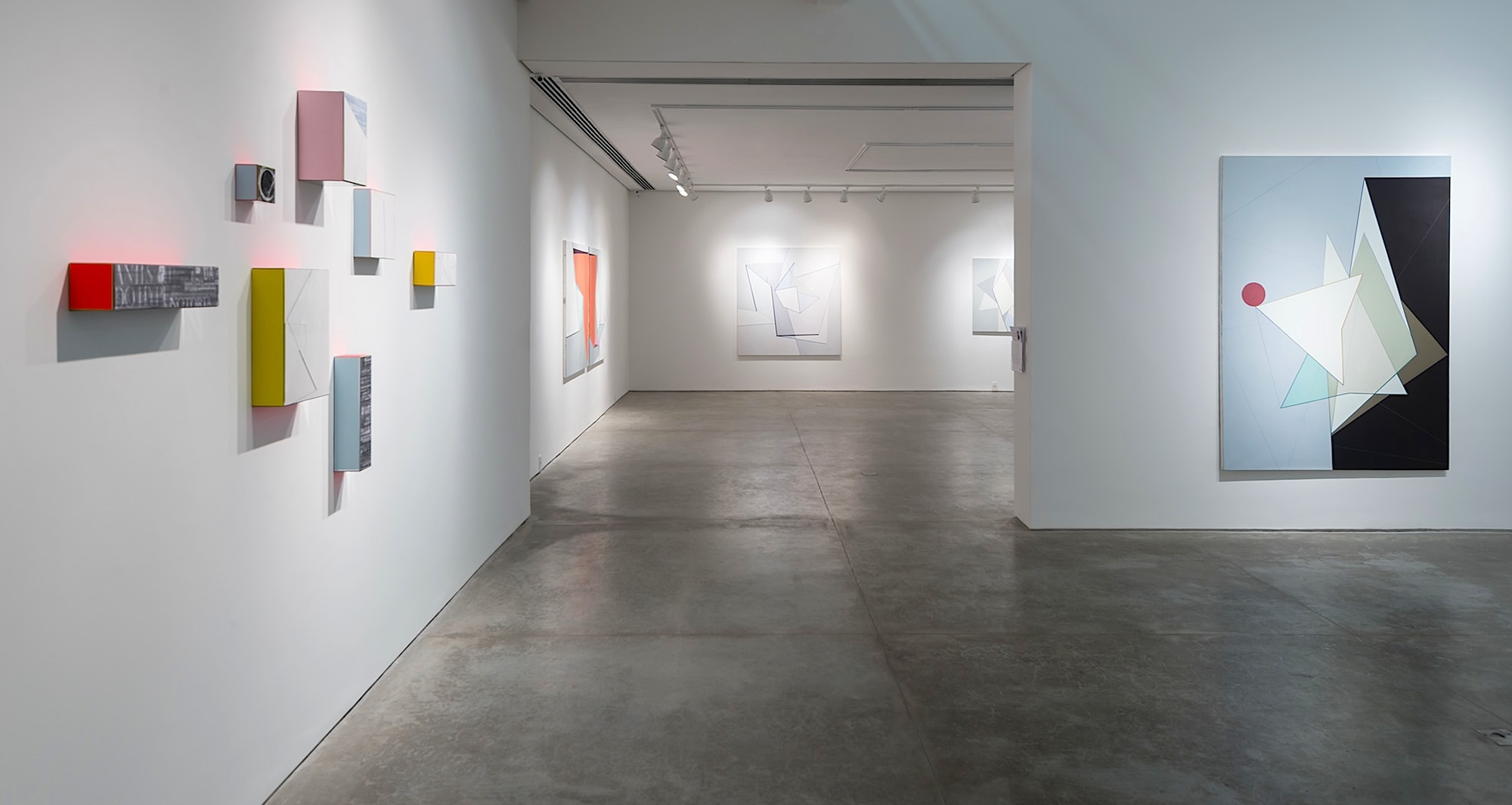
Le Corbusier's concept of 'ineffable space' exerts considerable influence on her current production. The French architect accurately defines the concept of ineffable space as the pinnacle of all aesthetic and spiritual experience made possible by architecture as the 'crowning of plastic emotion'. In this space that transcends any dimensional notion, aesthetic experience is lived through almost as an indescribable, irreducible, and perhaps better formulated in spiritual terms - no wonder that Corbusier's’ Ronchamp chapel is the best example of his theory. Borges' arts pursuit also takes place within this sphere of a total space lived through - fusion of architecture, painting and sculpture, uniting the perceptible and the imperceptible at the height of the unique aesthetic experience; experience that is expressed through lines and planes, lights and shadows, of sharp cuts and sequences, but which is ultimately transcendent. Her work has been unfolding in order to occupy the space of the world where there is no longer the limits of the disciplines: architecture, drawing, painting, sculpture, and to finally abolish the edges of painting. In fact her first concrete step of expanding painting in the world came with the small boxes with coloured borders, the interaction of color as light reflecting in the wall.
Another preponderant influence in the work of Borges has come through her experience with the work of Kurt Schwitters; his vision of art is more mundane than that of the French architect, but equally totalizing. When Isabelle was working with the artist Jack Ox, in her reconstruction of Schwitters' work, she experienced his work through the detailed drawing of Merz's fantastic construction. Schwitters' work was instrumental in the early development of experimental art. His use of the ‘combination, for artistic purposes of all conceivable materials’ obliges the viewer to experiment rather than simply to see art. His work created through collaboration with other artists and evolving with the constant addition of elements has required the viewer to take an active role in the interpretation and meaning of the work.
Borges tells me about this Dadaist influence: 'Dada collages also inspire me, they offer me a portrait of a changing time, a time of transformation in society, and collage offers me a quick means of recording this moment... With the collages I make with texts, I try to sort out the avalanche of information that we receive nowadays, but I do not conduct the reading, I always leave it free for each one to have its own interpretation.’ She works with newspaper clippings that were initially lining the floor of the atelier and had begun to capture her attention, the everyday life getting into the work. Borges makes use of the printed word, less like language and more as element causing noise, to break the homogeneity of the surfaces; it occurs through the forms of the letters and their possible connotations, deconstructing the text into enlarged images, offering new possibilities of meanings to the participant. This process of re-signification of art allows to bring language into the field of experience. The use of the text in the work of Mira Schendel has also a serious repercussion in the latest work of Borges.
The Neoconcrete art movement brought about this fusion of an utopian and constructive art, that makes use of mathematical and scientific elements, but breaks the paradigm to incorporate the concept of experience - Erlebnis in German. The spreading of a Philosophy of Life in Rio occurs also through Mario Pedrosa, who on his return from Germany has adopted these aspects of a Total Art, and as a thinker and critic was at the center of the rupture of the Neoconcrete movement with the Concrete one. Erlebnis is a common German word, which has the normal connotation of event, occurrence, adventure and experience, but as an art term it proposes an elemental change to the arts, grounding it in the inexorable field of life experience lived through.. The experience at the same time mundane and transcendent of art was experienced radically by the Brazilian artists in the 50s and 60s, and Borges retakes this path already traced by several predecessors, among those she cites are Lygia Clark, Mira Schendel, Lygia Pape, Helio Oiticica, Franz Weissmann, and others.
Borges brings in her luggage from Brazil to Berlin - where he studied, lives and works the Neoconcrete heritage and the theoretical and historical lessons learned in the courses taken at the School of Visual Arts, EAV Parque Lage, where in the late 1980s she attended. Here in Europe was the contact with modernist avant-garde art, with artists such as Kurt Schwitters, the expanded field of art, the search for the fusion of art and life that sediment her trajectory, but without losing the utopian aspirations of Le Corbusier.
The experience of all these predecessors are the influences that the work dialogues with in its achievement of a very personal language developed through almost three decades of work. The leap from the two-dimensional pictorial experience to the experiential space, the total space of art in this expanded field without frontiers. Borges is reaching to this balance of ineffable space through the drawings that extrapolates the edges, through the luminous poetry she builds on the walls, in the play of the colors that gently pop up here and there fighting against the blackened border lines or against the vast white and empty spaces. The pictorial space unfolding before our eyes in a continuous movement lead us towards this totalizing and comprehensive experience of art, of which Borges's work takes part.