
Magic eye
José Augusto Ribeiro
The strangeness in Adriana Coppio’s work is construction; it emerges from the making processes, more than from the motifs the artist chooses. An objective description would say that this is a set of paintings and drawings produced from previous images of occurrences, until further notice, prosaic. A part takes as reference family albums’ photos, pictures of common people, registers of a day or a special occasion in the life of anonymous children and adults or related to Coppio. Another part focuses on reproductions made by the artist or, mostly, selected by her in digital media and printings of landscapes, skies and clouds, bats, birds, a frog, a moth, a snail, a tree, cactus, a balloon, the façade of a house, the façade of a church, house interiors, a knickknack…
Beings, places and objects thus far banal, common that arouse curiosity – as they aroused the artist’s – mainly through photography. For the atypical disposition and dubious character that these elements took on in specific framing; for what they let see of their physical characteristics when observed from this or that angle; for the colors that cover them when reproduced in the respective image; for the past they refer to; or, in general, for the clichés that they repeat integrated to that photographic composition (clichés about beauty, happiness, leisure, about nature’s daily phenomena, but also about certain exoticism).
Thus, transfigured in Adriana Coppio’s work, what would be considered trivial and ordinary, what maybe would inspire purity in action and feeling, presents as enigmatic and sinister. From the innocence and enchant of childhood, from the angelical and communal religiosity also leak perversities. The apparent simplicity of a circumstance, a gesture, a decorative item reveals itself, like never before, vulgar, tacky, uncomfortable even. What occurs with these materials, with these scenes are not even proper twists. Actually, it’s Coppio’s painting that instills, with the resources available, an atmosphere of discomfort, suspense and mystery in these action units.
Starting by a fluorescent and artificial luminosity that invades the space of the canvases. This light – of an annunciation, a nuclear radiation? – comes from behind the figures and intrudes little by little through the interstices, the painting motifs, until it arrives, sometimes solid, flat at the very first plan – look, at the door of a Catholic church or at the entrance of a cylindrical building that, with the reddish roof, recalls a mushroom (or a giant penis) and, therefore, could be the house of a goblin. This psychedelic intensity that permeates Coppio’s images arises from the way the artist prepares her canvases to create her work, through the homogeneous filling of the “background” that seals the cloth thread, with yellow, green or pink acrylic paint.
The chromatic effects of the operation, while granting an acid, uncomfortable atmosphere to the painting’s motifs, give the results some of the appearance of graphic printings of photos and colorful illustrations of books and magazines from the period between 1950 and 1980. And, in these solutions, the work borrows an aged aspect – neither anachronistic nor outdated, but time accumulating, with the perception and character that would only be formed today. This is, indeed, a quite contemporary experience: dealing, through painting interested in photographic, cinematographic and digital images, with speeding time and with pasts that, in many senses, manifest in a ghostly way – with open questions, with fictional dimensions, producing, today, obsessive movements, by evoking supernatural phenomena – and that, thus, insist in making their appearances and haunting the present.
Actually, many images in Adriana Coppio’s work drag along the passage of time – a reminiscence, an affectionate discourse and, at some point, death. What haunts the drawing that reproduces a photo of that pair of children sitting on a rock? A friendship, the experiences of a trip, promises for the future, news about a crime, the prediction of a tragedy? Or is this an idea planted on the viewer’s mind, as a reflex of a certain language used in journalism and TV or cinema documentaries that conditioned spectators to envision personal stories from photos of the past of someone who is not a public figure, that we don’t even know, and whose smiles are used to generate identification and commotion during the narrative, I don’t know, of unfortunate plots? It is a fact that any photo of a remote past carries within it, want it or not, the end of something or someone.
The children dressed in bunny costumes, present in the exhibition, are they partying while they dance in front of trees licked by fire? The peacock placed against a wood board, what does it do? Animal and object rival shapes, prints, stains, sources, colors, patterns, until the distinctions between them crumble at the lower part of the painting? Would that be a special kind of disappearance, through the contrast between two exuberances? Because there is no drawing that precedes Coppio’s painting and the figures painted by her, therefore, have no clear and marked contours.
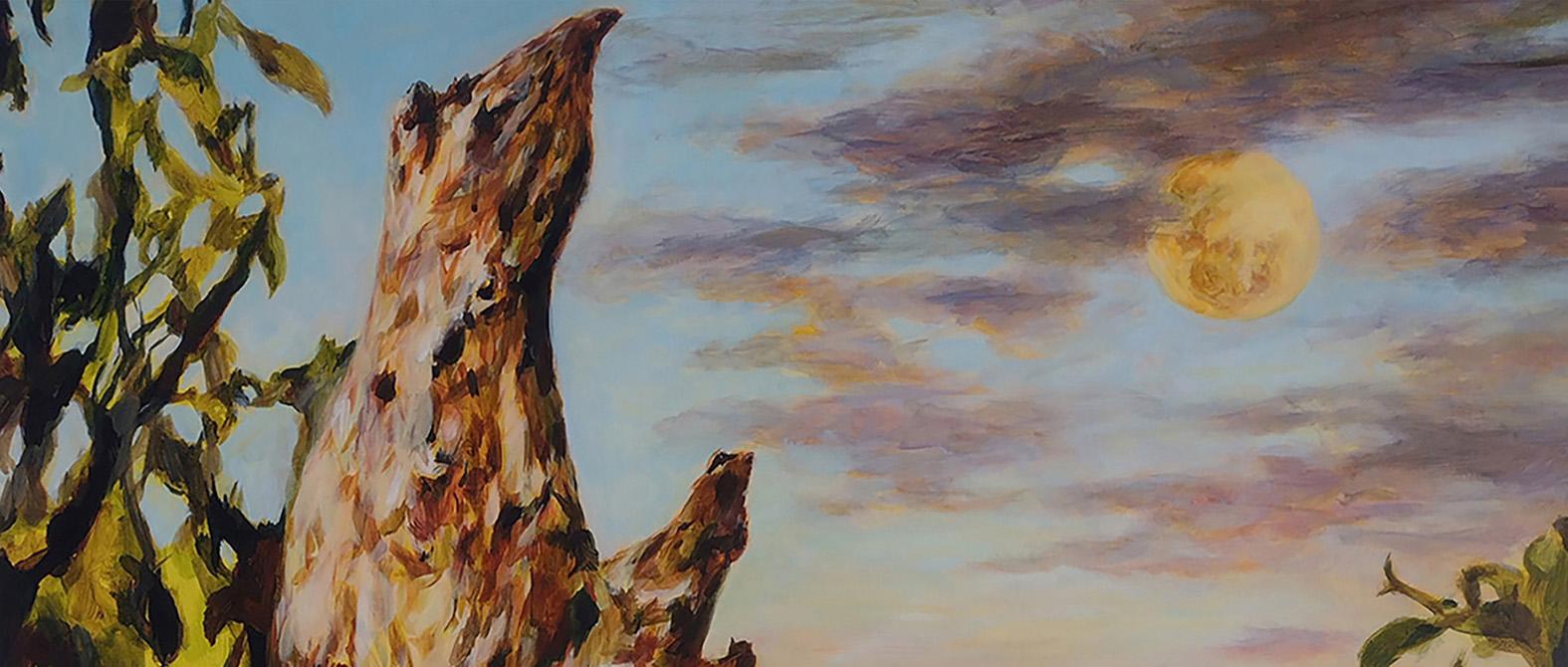
In the making process, the color overlapping is noticeable due to the transparencies – what, in general, warms the image up. The distinctions between bodies, things and spaces are subtle and uncertain; made by the chromatic transition and direction of the brushstrokes. The limits between one figure and the other flame, vibrate. And these decisions, not rarely, make the image blurry, with the appearance of a vision through lenses and unfocused; as if that complex painting structure organized itself to carefully prepare and firmly exhibit imprecisions, a supposed flaw, a supposed mistake.
Before finishing the Arts course from FAAP (Fundação Armando Álvares Penteado), in São Paulo, at the end of the 1990s, Adriana Coppio’s painting started to occupy a singular position in the city’s art scene. Coppio, aware of the works of contemporary artists at that time in Europe and the United States – especially the ones by Gerhard RichterLuc and Tuymans which, for this purpose, can perhaps be grouped between paintings carried out based on photographic reproductions and paintings with pallets of cold, quiet colors - was in São Paulo among a relevant number of painters dedicated to researches on the gestures and materials of this language (pictorial), simple abstract shapes, diagrammatic games between color fields, the possibilities of paint and surface textures (whether smooth or rough, homogenous or irregular, with a lot or little matter, etc.). Some of them interested also in taking painting to other surfaces beyond the canvas – and not exclusively planar.
Only later, at the end of the 2000s, groups of newly-graduated artists wiling to speculate about the conditions of a figurative painting at that time started to emerge.3 Now, it is very curious how the superseding of false moralism by Adriana Coppio’s work has stood out in the last four or five years, when the artist’s work started to circulate more frequently and with significant public visibility. This ubiquity found in her painting and that suspends the state of things between the ordinary and the amazement, puritanism and cruelty, candor, kitsch and violence, may have a lot to say about today’s Brazil, where, lately, rigid behaviors and morals have been defended publically by cynical, obscene, aggressive, corrupt and biased people. Despite the outrage it sparkles, this bunch of lies, brutality and vigilance seems to be part of a hallucination. But it is in place.