
ROBERTO ALBAN ART GALLERY PRESENTS SOLO EXHIBITION OF THE RIO-BORN ARTIST RAUL MOURÃO
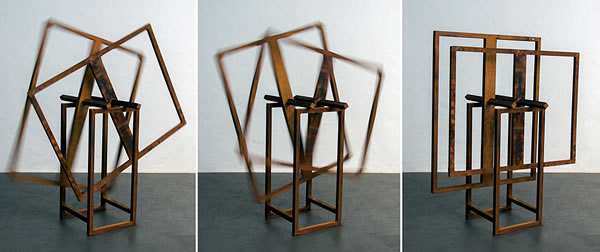
Movimento Repouso is the title of the first exhibition of the Rio-born artist in Salvador. The unprecedented exhibition was entirely designed for the gallery’s space and reunites a group of 10 sculptures in Corten steel and 34 photos taken between 2012 and 2013.
“Since 2010 I have been developing a series of kinetic sculptures that have already been presented in Porto Alegre, Rio, São Paulo, NY and London. It’s a very ludic series that requires the public’s participation. It’s the spectator’s touch on the work that starts the movement and creates a new condition for the sculpture, a second live moment”, says the artist.
Besides the kinetic sculptures the artist presents 34 photos of the series Timeline initiated in 2012.
“They are snapshots of life, photos of the daily life, an eye in search for small visual accidents. I started photographing in the end of the 1980’s when I studied at Parque Lage, there the photos were visual notes of the urban landscape that later became the series Grades. I was away from photography, but in 2012 I started the series TIMELINE where again I address the city’s landscape and its sub architectures. It’s an anarchic exercise of permanent observation, photography hits one on the face like a slap, it’s not a built, prepared image. There’s nothing of the solemn attitude of searching for the photo, it’s the photo that presents itself”, says the artist.
In the catalogue’s text the essayist, researcher and literature professor Frederico Coelho comments the exhibition’s title: “In these days of forced renewal of the country’s political and social reality, evoking a Movement that requires rest is an invitation that can’t be refused. Not of emptying, but of renovation. Resting the eyes on the work, resting the hands on the swings, resting the days on Art, to, who knows, renovate the energy. After all, every little movement – be it of the steel, of men – will always be a revolution.”
About the artist
Raul Mourão is a plastic artist, who was born in Rio de Janeiro in 1967, studied at the School of Visual Arts of Parque Lage and nowadays lives and works between NY and Rio. He has presented his work in solo and collective exhibitions since 1991. His works, built in various materials, develop a plastic vocabulary with elements of the urban visibility displaced from their usual context. Among them there are references to sport, architecture, botequins (typical Brazilian bars) and the signaling of public construction works.
In 2010 he initiated his series of kinetic sculptures that were exhibited in the following solo exhibitions: Tração Animal at the Museum of Modern Art in Rio de Janeiro; Homenagem ao Cubo at Lurixs Arte Contemporânea, Rio de Janeiro; Processo, at Studio X, Rio de Janeiro; Toque Devagar, at Tiradentes Square, Rio de Janeiro; Balanço Geral at Atelier Subterrânea, Porto Alegre; Cuidado Quente at the Nara Roesler Gallery, São Paulo; Chão, Parede e Gente at Lurixs Gallery, Rio de Janeiro. . And also in the collective exhibitions Projetos (in)Provados at Caixa Cultural, Rio de Janeiro; Ponto de Equilíbrio, at the Tomie Ohtake Institute, São Paulo; Mostra Paralela 2010 (Special Screening), at Liceu de Artes e Ofícios, São Paulo; Travessias , at Bela Maré Art Center, Rio de Janeiro; and From the Margin to The Edge, Sommerset House, London.
As curator and producer, he organized solo exhibitions for Fernanda Gomes, Cabelo, Tatiana Grinberg, Brigida Baltar and João Modé, among others, and the collective exhibitions Travessias 2 (Galpão Bela Maré, Rio de Janeiro), Love’s House (Hotel Love’s House, Rio de Janeiro) and Outra Coisa (Vale Museum, Vila Velha). He was editor of the art magazines O Carioca and Item. Raul was also the general coordinator of the multimedia spectacle FreeZone, which reunited artists from different areas and had as curator the poet Chacal, in Rio de Janeiro, Curitiba, Porto Alegre and São Paulo. Together with Eduardo Coimbra, Luiza Mello and Ricardo Basbaum, he created and directed the gallery and production company AGORA, in Lapa, Rio de Janeiro, between 2000 and 2002.
In 2005, he launched the book ARTEBRA by the publishing house Casa da Palavra and in 2011 launched the book MOV by Automatica Edições.
Open for balance
Author:Frederico Coelho
Since 2010 Raul Mourão has been working with kinetic sculptures. His research on materials and movements brought a new aesthetic route to his work. In a trajectory marked by the eclecticism of means and action fronts, Raul plunged in this universe and concentrated for a period of time in his swings. His last exhibitions explored the multiple possibilities in this relationship between the steel’s raw material and its lightness through subtle pendulum movements. If before his work could sometimes imprison the eye between bars, from the swings it started to invite the spectator to dance.
His new swings, made especially for this exhibition, show us how the themes and shapes of these sculptures keep expanding in a kind of infinite combinatorics analysis. The engineering of the balance becomes more and more diffuse and ludic. The shapes are free to break an appearance of countenance for a salutary dispersion of ideas. This occurs because, despite the rigidity of the steel, they emerge from drawings made by Raul. In the origin of these rational and metallic sculptures, there’s the free and dreamlike line of the drawer’s hand. In a way, we may see in these current swings, internal dialogues with his previous works, like the first sculptures in the exhibition “Humanos” (1993) or the works of “cadernos de anotações”(2003). In all of them, we see the hand of the drawer creating geometrical and, at the same time, organic shapes, in order to later adjust them to the demand of non-malleable materials, such as metal.
In MOVIMENTO REPOUSO, therefore, Raul keeps expanding the possibilities of his research, however with a new element at stake: the transience. Nowadays, Raul lives in Manhattan, United States. The daily life in his atelier in the district of Lapa, Rio de Janeiro, is replaced by the frenetic rhythm of the American “Babylon”. An always attentive and street oriented artist, Raul soon made the corners of Manhattan his; with his mobile, captured through photos the blind spots, the shifting of the eyes, the approximation of the universal shapes, turning objects and scenes of the urban daily life into small universal microcosms. They are micro-narratives of the flaws, lights, colors, objects. His photos, besides his current swings, show us that Raul is again investing in multimedia for work exhibition, looking once more for a kind of bigger amplitude.
The artist that lives between countries, cities, languages, starts to jeopardize a comfortable space of action and needs to adapt himself to the hybrid component that is installed in his works and in his world vision. A kind of shattering of the certainties impels Raul to reinvent references and not to separate his daily life in the streets (photos) from his reflexive work about language (swings). At the moment, the duplicity (of cities, of means) and the out of place perspective of the photographic images are evidence of a moment in which research and reflection, action and contemplation, are adjusted in the exhibition space and dialogue in multiple ways with the public and with each other.
In conversations before his move to Manhattan, Raul Mourão mentioned a name for a work project during his initial stay in the city. The name: Landing Project. A project made by those who are landing on a new reality. Maybe due to an unnoticeable relationship, the choice of the verb land as the title of this exhibition refers directly to the project outlined still in Brazil. Land/rest ideas, bodies, works, lives. I believe, however, that here, his MOVIMENTO REPOUSO is much more than this. In these days of forced renewal of the country’s political and social reality, evoking a Movement that requires rest is an invitation that can’t be refused. Not of emptying, but of renovation. Resting the eyes on the work, resting the hands on the swings, resting the days on Art, to, who knows, renovate the energy. After all, every little movement – be it of the steel, of men – will always be a revolution.