
The Subtle Nature of Painting
Marcio Sampaio
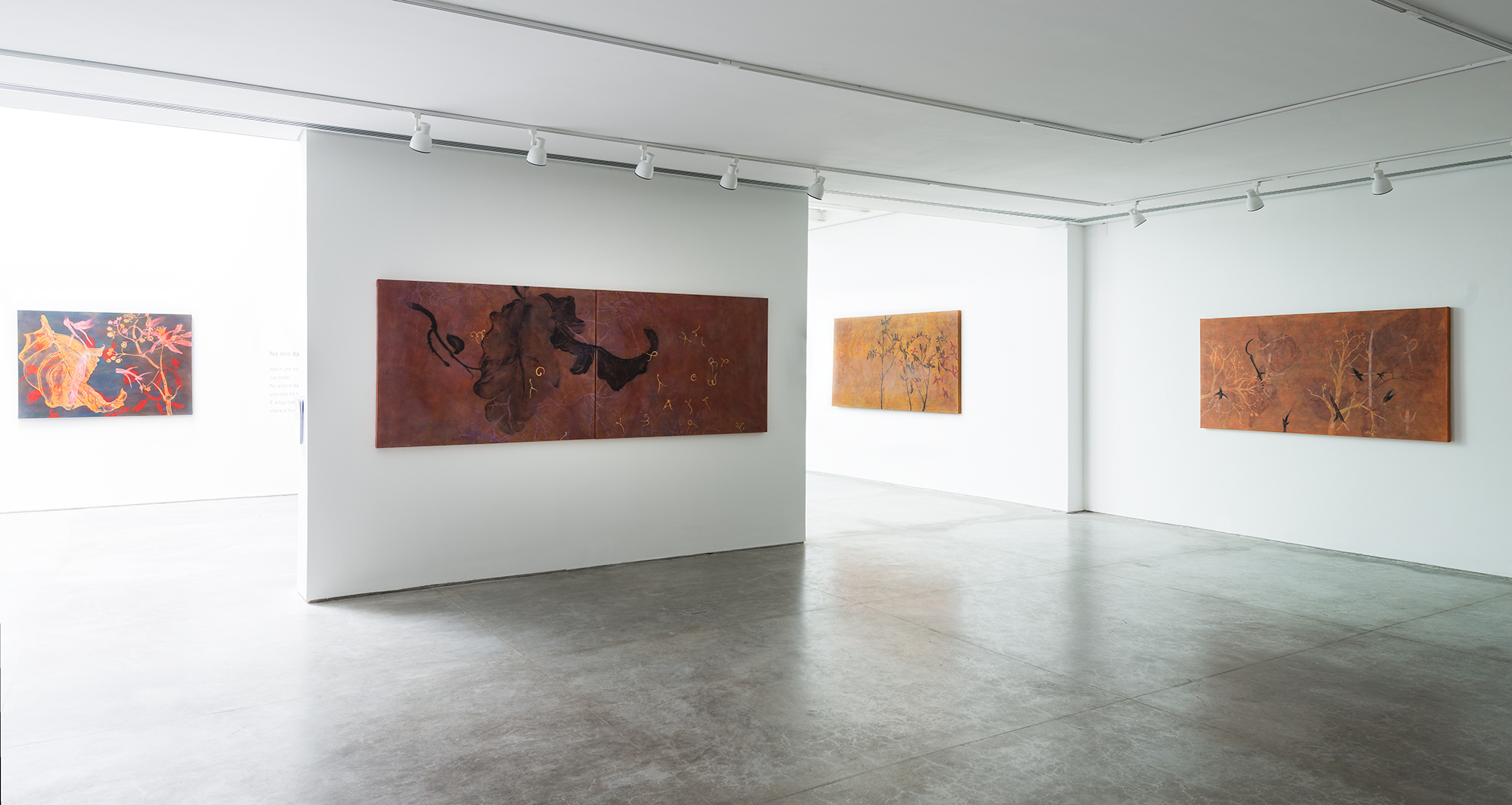
The paintings by Liliane Dardot invite to an exercise of wandering. Like nature itself that grants her theme and material, it’s a painting that sediments little by little, in its apparent austere conformation, but that, in the end, blossoms in celebration of shape and color. It’s a painting that takes up a time, in precise seasons – from the preparation, seeding, maturation, until harvest – as actions, real events and not metaphors. They’re acts that are accomplices of the time, translations of desires and expectations, resolutions and waiting: from the project, the preparation of the canvas, the collection of pictorial material, to the launching or transcreation of the shapes apprehended from nature.
Paints, earth, pigments are prepared and used as literal fertilizers to make shapes blossom. The material has its time of action, decantation, impregnation, its maturing, in the almost microscopic transformation operated by the sedimentation of these mixtures, until that finally, this precious harvest named painting can be picked.
There’s a new meaning for this painting, delicate and at the same time resolute, strict in its realization, touching in its silence full of subtle rumors, as we listen in the actual nature that motivates it.
It’s not the “landscape painting” in the genre sense, but a painting that touches nature and elements of nature in effigy – flowers, fruit, trees, seeds, forests, valleys, plans, lights, shadows, fog, layers of air. If these elements are to a certain extent perceptible, they’re more than representations, they’re conduits of a line of interest, construct of evocations (in Arthur Alain Feinnes’ saying) through which we become receptive to so many other issues sowed, issues that are essentially of language and painting’s language.
There is, in this painting so full of refinement, a thing of time, action and fruition. It’s constructive, in a sense different to the planar geometrical painting.
Its constructiveness is deliberate in the temporal dimension, when the execution time internalizes a game of co-incidences that allows the apprehension of optical facts, according to the dislocation of the observer, in the same way that the differences of light (intensity, wave, color quality, opacity and shine) equally produce different perceptions, veiling and unveiling, accentuating and revealing plastic happenings (images, textures, colors), mysteriously begotten in the interior of the space.
Thus, the painting proposes a more dilated and concentrated fruition time. “Aspects such as alterations of the light throughout the day, or the dislocation of the spectator in relation to the picture, may lead to some discoveries deriving from the different degrees of visibility”.
These possibilities turn the observer into a performer: reading becomes a physical, mental and poetically active act.
This way, the painted canvas becomes a place for the practice of fineness, perceptive refinements, as it is for the artist: seedbed where the shape decants, where the refined residues of the material land in silence, this silence full of meanings that makes the fruit of the land germinate. Of painting.