
The collector in the forest of signs
Roberto Conduru
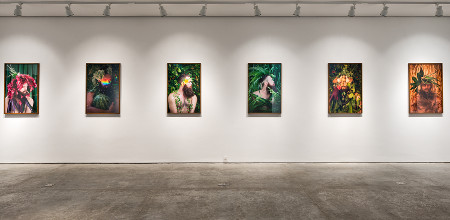
A dynamic at the same time centripetal and centrifugal constitutes Alexandre Mury’s works. He makes himself omnipresent to represent others, to be many others. Now, he lends his body to Exu, Ogum, Xangô, Iansã, Oxumaré, Oxum, Oxóssi, Ossanha, Obaluaê, Nanã, Iemanjá and Oxalá.
At first, the new series – Orixás – may suggest a rupture from his previous work. However, it’s possible to note how he unfolds his previous work, encouraging us to see them again in the light of his current moment. It’s no surprise the focus on deities, considering, for example, his São Sebastião, Shiva and Zeus Amon. Surprising is the way that they’re represented.
Formerly secondary, a hierocracy sometimes sober, sometimes dramatic or lyric acquires prominence. But the sacredness inherent to the religious theme doesn’t preclude the somewhat heretic humor that has characterized his images. Not so much for making explicit his masculinity in representations of female orixás, because the relativisation of genders is something experienced in the terreiros with the fusion of differences in conjunctions of natural and divine bodies. What can cause more uneasiness is his naked body, without visible marks of initiation and at first classifiable as white in the complex pallet formed by the ethnical-racial relations in Brazil. If nudity goes against religious dictations and habits, for many it can be bold for someone who isn’t Afro-descendant or initiated to present himself not only as one but as twelve orixás.
If Mury usually explored diversity to give life to his enactments, in his prior solo exhibition, Eu sou a Pintura, he focused on monochromes. Although green prevails in his most recent series, the color is of less interest and the self-limitation of the artist to the flora is of more interest. Kosi Ewè Kosi Òrìsà; simple, direct, deep, revealing is this Ioruba saying – without leaves there is no Orixá. Paraphrasing this expression essential to Candomblé and other religions of African origin in Brazil: without leaves there aren’t Orixás. To represent the dieties of the Afro-Brazilian pantheon, he took this law as principle for action and used only leaves, flowers, fruit, roots and other botanical elements.
Orixás’ patron is Ossanha, the Lord of the Leaves, who rules their liturgical and medicinal use. A choice that allows us to think about other political dimensions in Mury’s work. These images are linked to ecology. Without leaves there’s no Orixá, nor photosynthesis and, therefore, oxygen, life in the planet. The experimentation with matters in natura guides also the series Os Quatro Elementos, with representations of fire, air, earth and water. Elements that, as the foundations of the Orixás, determine the structuring of the images in the exhibition space and in the catalogue. Subtly, these series refer to the global crisis caused by deforestation, lack of water resources, warming. They talk about how water, air, earth and the Earth deteriorate.
Orixás is also political when propagating new images of Afro-Brazilian deities. It reiterates Candomblé’s vitality, the up-to-dateness of its worldview and of its sacred imaginary. And it restates the need to divulge them in a social conjecture marked by restrictions and persecutions of African religions in Brazil.
Another differential of these series is the fact that Mury created his own representations. Without starting from pre-existent works, he avoids explicit references to exponential icons of art history and visual culture. His images are his own because the artist gives them flesh, surrounds himself and dresses with matters that are essential to the beings represented: the elements of nature and the leaves specific to each Orixá. They’re his own also because they’re his creations and nobody else’s. Before, beyond his presence, his subjectivity was outlined as he collected images and conjugated additions and subtractions in the rereading. Now, it takes other risks, manifesting itself from the guiding scheme to the details of each mise en scène.
Even if the imagination carries more weight now than the memory, the dialogue with the History of Art remains, announced since the first hour of his trajectory. Besides revisiting the four elements theme, relations between sights and artistic fields, between objects of vision and ways to see reverberate. While the Orixás have vertical framing that is more associated to portraits and self-portraits, the images of nature elements have a predominantly horizontal shape – a novelty in Mury’s work – which is traditionally used in landscaping representations. In this sense, the last series leaves a question: do horizontality, landscaping and minimized self-image announce a new path in his work, less centered in the human figure, less self-referent?
The confrontation with the History of Art also persists in the dialogue that Orixás maintain with some series of representations of Afro-Brazilian deities. Without quotations, these images align with other interpretations of this pantheon. Specially, with the photos published by Pierre Verger in his book Orixás, the representations made by Carybé in different media and, more recently, the compound Bori by Ayrson Heráclito. While the drawings, paintings, sculptures and prints by Carybé are graphic re-elaborations of his experiences with religious life in Bahia, inside or out the terreiros, Verger and Heráclito’s series are more immediate registers: in the first case, of religious rituals; in the second, of an artistic performance. The performance of a rite is also fundamental for Mury’s images to come to light. Multiple, unmistakably artistic, his enactments were less public and more mediatized, deriving from actions that, although, took place many times in collective use spaces, converged to spaces restricted to the acting of the artist and his few collaborators. En passant, note that: situations that aren’t exempt of magical glimmers. Characteristics that approach his series to the poses photographed in studio, in black and white, by Mário Cravo Neto, some also representing Orixás.
Having in view the power of Candomblé and the art dedicated to the relations between Brazil and Africa in Bahia, Mury considered it necessary to go there to carry out Orixás. Little wonder, he understands this series as fruit of an artistic residency. A residency in transit, I would say, through territories consecrated to deities: São Salvador and São Fidélis, among others. It can be said that this series was initiated a long time ago, in the artist’s hometown, in the north of Rio de Janeiro, with the garden formed by eatable and medicinal plants, therefore of a more useful than aesthetic nature, cultivated by his mother, Hilda de Carvalho Mury. In fact, to make Orixás, it was necessary to collect leaves. Literally, pick them in gardens, yards, herb shops, woods, forests. Metaphorically too. In Candomblé, they say that someone collects a leaf when they learn something. In fact, Mury acquired knowledge, collected leaves in Candomblé, in art and beyond.
The productive process of the images and the interlocution with the works of Verger, Heráclito and Cravo Neto make us think if photography is the fulcrum of Mury’s work. On one hand, it is. As his previous work, this series exists because photography exists. In the case of Orixás, the speed of the photographic process is essential to preserve the fugacious existence of these tableaux vivants, sometimes with very brief temporality due to the short life of some leaves and flowers. In parentheses we may ask: is there contemporary art without photography? On the other hand, it’s not. Mury is less interested in photography itself and more in the event, its momentary performance, almost like an ephemeral sculpture, in a live scene captured by light, processed and filed electronically, printed on paper.
In this sense, it’s necessary to point out how the re-reading made by Mury of an image of Ossanha created by Carybé is the exception that confirms another way of meaning, even though not entirely new, or understood as rule. Like Ossanha, he inhabits the forest. But his forest is made of another matter. Its leaves are the signs, also rich in their variety: icons, indexes, symbols; mixed up signs, because he knows that, as it occurs with the leaves in Candomblé, the magic results from the mixture. The indicial quality is the one that stands out the most in these images composed by luminous traces of happenings. However, if they don’t echo pre-existent images, they maintain the iconicity in the figuration of the botanical elements and the artist, already instituted as icon, in his work and beyond it. And potentiate the symbolic dimension, either because, more than finishing lines, the Orixás open multiple meanings, or because with them, as seen, Mury says much more.
Mury enters the woods, the forest of signs, to collect the leaves and improve the mixture. And knows that it requires sacrifice, it’s necessary to offer the body for the sacred to be installed. Sacred in art, of course. Like the ethnography that precedes it, in these images the incorporation is artistic. Centripetal incorporation, but little self-referent, because it aims at the corporeity of art – to the body of the work and, centrifugally, to the bodies connected to it. The image is embodied, acquires body when it’s luminously printed on paper. But it’s up to its body, minimum as it may be, to connect the bodies of the artist and the public. What would allow us to open other parentheses and question if there’s contemporary art without body. However, these series and Mury’s previous work give rise to something deeper, though obvious – without body there’s no art.