
Peles do Cárcere (Skins from Jail) - Willyams Martins
August 2nd to 31st, 2013
Roberto Alban Art Gallery
Rua Senta Pua nº53, Ondina / Salvador, BA,Brasil.
Monday through Friday from 10 AM to 7 PM / Saturday, From 10 AM to 1 PM
Phone: 55 71 3243-3982
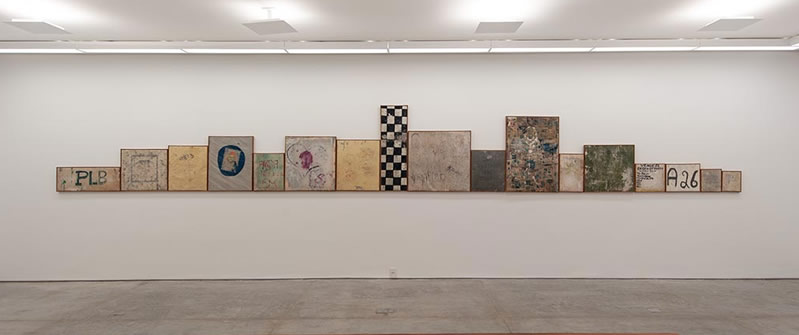
The Roberto Alban Art Gallery presents the exhibition: “Peles do Cárcere (Skins from Jail)” by Willyams Martins, which will fill the gallery with 30 unprecedented works of art, from August 1st, for special guests, and August 2nd for the general public. The presented works are part of the Peles Grafitadas (Graffitied Skins) series, made up of images from city walls produced through the technique of removal and displacement. This time, the artist researched and detached worn images present on the walls of the Lemos Brito Penitentiary, where the prisoners had recorded their subjective expressions over the years.
In Peles do Cárcere (Skins from Jail), Willyams Martins is exhibiting the researched work, done in the Penitentiary Complex, in its entirety. “The wall of the prison becomes a mediating means of support from where signs of social and artistic reference are taken, displacing a visual production, a repertoire of identification”, the artist explains. Thus, Martins's art takes a careful look at life in jail, with ethnographic aspects, and is simultaneously in harmony with and in opposition to the strictly urban daily routine of modern life.
The exhibition has the financial support of the Fundação Cultural da Bahia (Cultural Foundation of Bahia), through the endowment of the Secretaria de Cultura do Estado da Bahia (Secretary of Culture of the State of Bahia) – SecultBa, where 105 projects wre submitted but only 15 were considered. The show Peles do Cárcere (Skins from Jail) aims to cast a different light on the ordinary images that exist on external walls and urban surfaces. In close proximity to the viewer, the images on display become objects of analysis. “The images, which were imprisoned, form a polyphony of meanings, producing a connection between the near and far, internal and external. That which was taken from the wall, now displaced, is free”, the artist explains.
The images that make up the show were taken from the prison by a technique of removal, which uses voile fabric and polyester resin applied over the image to remove the “skin” from the surface. The content of the drawings carries poetic, philosophic and abstract connotations about the life and daily routine inside and outside of jail. “During the research I could count on the help of some detainees. Thus, I succeeded in lifting the images from inside the cells and, there, I came across diverse drawings, paintings, numbers, phrases, sketches and collages; Images that prisoners produce as an outpouring of emotion, showing their subjectivity, their individual traits, reflecting their unique features”, explains Martins. Many of the walls, from which Willyams removed images, were repainted during the general renovation taking place at Lemos Brito. The process of image liberation has preserved, on the screen, what would otherwise have been lost to the renovation. PUNK Movement– Besides urbanism, the music and esthetics of Brazilian Punk are sources of inspiration for the art made by Willyams Martins. Martins was one of the founders of “Dever de Clase (Classwork)” in the 80s. “In my musical era, I used to like walking at night so, I would see this degradation, the many languages exposed in the city labyrinths. It was a real clustering of counterculture concepts and of conceptual art. Urban art has a metalanguage that enables the evolution of the definition of art. The art sets up new world realities. The are that we create is much more provocative, reflective, which encourages new connotations of reality instead of only being used as a decorative object”, concludes Martins.
“The goal is to engineer a power circuit, capable of connecting the good vibrations of mangroves with the worldwide network of pop concept circulation. Symbolic image, a parabolic antenna stuck in the mud.” (Fred Zero Quatro)
“Oh! Saint Dimas, you were the Good Thief, stealing heaven and conquering the agonized and merciful Heart of Jesus, you have become the model of trust for sinners and the repentant. By the wounds of the Crucified Jesus, in life and in death, may I be justified!” (Selection from the Prayer to Saint Dimas)
Unauthorized tags, graffiti, posters, gouges in public and private spaces. Dissolution of the pigments of urban walls, removing the body of the city: transgression squared.
Heir and protagonist of the punk movement in Salvador in the 1980s and 90s, Willyams Martins is shifting the focus of the spotlight from the stage and is diving into the visual arts produced in the shadows of the streets. In this urbunderworld, where a power struggle is constant and "going over a tag" has become cause for death, Martins is subverting and radicalizing the game. He is extracting paintings from the streets and introducing them into the contemporary art circuit, under his authorship. The “skins” are introjected into an aseptic artistic system, contaminating the purity of the gallery.
This artistic appropriation was widely used in the surrealist collages, more than becoming icons of Pop Art. Mimmo Rotella requisitioned traumatized posters from the streets and, going down this path, we come to Sherrie Levine, who in After Walker Evans, seizes the photographs of the famous American and sells them with her signature. With Peles Grafitadas (Graffitied Skins), Willyams is creating an authorship network node, by exhibiting images that have been removed from public walls, engaging new concepts and reconfiguring them in the exhibition space, like an imminent bricoleur.
Jail brings together beings of transgression, who are prisoners because they have infringed upon the penal code, as well as for belonging to a particular socio-economic group. By entering this universe and bringing it outside the walls, Martins fully reveals a symbolic universe, bringing forth love, beliefs, delusions, and ultimately, the humanity of people who are forced to kill time in this perfect panoptic. He is revealing another artistic hemisphere to us, beyond providing a socio-anthropological interpretation of this isolated tribe.
Francilins
Willyams Martins,
Lives and works in Salvador, BA - Brasil
www.martins.art.br
A Visual Artist, with a master's in Visual Arts, Artista Visual, mestre em Artes Visuais, Escola de Belas Artes (College of Fine Arts), Universidade Federal da Bahia (Federal University of Bahia). He has ample experience in workshops in various cultural institutions, such as, “Laboratório Instantâneo (Instant Laboratory)” of contemporary art presented at the MAM-BA, in relation to the 29th Bienal de São Paulo (São Paulo Biennial) – Selected Works. His transversal works are permiated by the articulation of diverse esthetic fields. He participated in the documentary “Paredes Que Hablan (Walls that Speak)”, for Mexican and Argentinian TV. He participated in a collective exhibition in Bogota, Colombia. Recently, he has been exhibiting individually in the Estação Central do Metrô (Central Metro Station) in Belo Horizonte, MG. He was selected for the 11th Bienal Nacional de Santos (Santos National Biennial), and his work, titled “Peles Grafitadas (Graffitied Skins)”, was received an award from Braskem de Cultura e Arte, besides having been selected for several endowments, etc. Currently he has been selected for the “Salinas Compartilhada (Shared Saline)” workshop for the Programa BNB de Cultura – Edição 2012 (2012 Edition), and he was cited in the doctoral thesis: Enterros: Momentos Especificos (Burrials: Specific Moments), by Rebeca Stumm. He has been a professor of Painting I and Painting Theory and Technique, in EBA, UFBA. He is currently professor of Design VI (murals) and Artistic Processes at the same school.
FRANCILINS, 1978
Lives and works in Belo Horizonte, MG and Salvador, BA - Brasil
www.francilins.com
+55 31 99870402
+55 71 91734867
A Visual Artist having graduated from UFMG in Anthropology and mastering in Visual Arts at UFBA. He has ample experience as a photographer and editor, is flirting with cinema and is producing hybrid works in a contemporary art context. His transversal works are marked by the crossing and articulation of diverse fields in the Humanities.
He has participated in dozens of collective exhibitions in Brazil, Spain, Netherlands, the USA, Peru, Mexico, Estonia, Slovenia and Dubai, and also held four individual shows. In 2012, he confirmed solo exhibitions in Uruguay (CMDF), Spain (Durango/Bilbao) and in the SESC-Paladium Gallery (Belo Horizonte).He is the visual arts curator at the FAN – Festival de Arte Negra (Black Art Festival) in Belo Horizonte, he coordinated the seminar Coaxar Coxanino: Artes e Sertão (FUNARTE Rede de Artes Visuais (FUNARTE Visual Arts Network) Award -2009) and also curated the photographic shows for forumdoc.bh (2005, 2006). As an educator, he teaches undergraduate and graduate courses, as well as training workshops in visual arts and their interaction with the humanities and social sciences in various art festivals. He has presented papers at major scientific meetings, RAA (Argentina), ICA (Mexico), ANPOCS, ABA, among others.
He was awarded and selected at several Art and Photography Halls, among them: Prêmio Wessel de Arte (2008); Prêmio Diário Contemporâneo (2011); Porto Seguro de Fotografia (2005), Leica/Brasil(2003), Picture of the Year – USA (2003), Arte no Ônibus (Art on the Bus) (2003), MEMEFEST - Slovenia (2004), Itaú-BBA (2002, 2003, 2004). He received a grant from Itaú Cultural for the portfolio presentation at the II Fórum Latinoamericano de Fotografia (II Latinamerican Photography Forum) in São Paulo (2010) and he was interviewed on Paraty em Foco – Festival Internacional de Fotografia (International Photography Festival) – about the homage to Fotografia Mineira (2010). He developed and defended a thesis in Anthropology at UFMG, the first work in imagery support accepted as a monograph/dissertation/thesis at a Brazilian university, the book will be published by the end of 2012. In 2010 and 2011 he was the photo editor of the magazine Sagarana (www.revistasagarana.com.br) and has hundreds of photographs printed in the pages of books, newspapers and magazines, such as National Geographic. Bravo!, Sagarana, State of São Paulo and Fotografe Melhor.