
An unstable whole
Ronaldo Brito
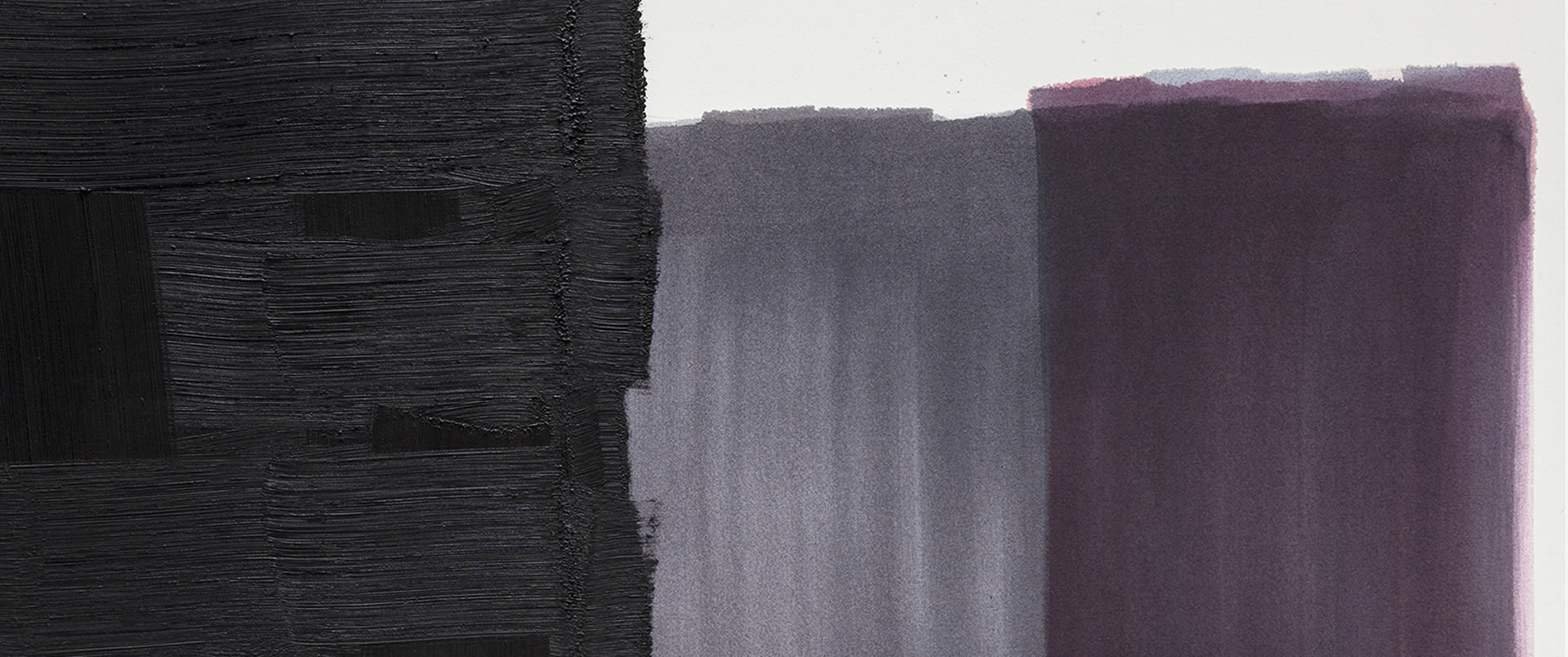
The paintings by Célia Euvaldo begin with a physical and ostensible presence. They do not evidently have, however, a beginning, middle and end. Lacking any narrative content, they seek to assert their full appearance to the maximum. And because these paintings need to attract and intrigue an attentive perception, which would focus on them and do them justice, they depend on their continuously renewed capacity to be problematized. Visibly, they result from disparate if not conflicting pictorial moments. On the condition, however, that they end up all together! In short, their destiny is to constantly pursue, anew, their own, uncertain realization.
When controlling his or her media and modes, mastering his or her craft, and delimiting his or her poetic territory, every artist runs the risk of sterilizing them. A notorious, trivial and terrible risk. In Célia Euvaldo’s case, this risk is heightened on a considerable scale; an imminent danger lurks all around these large paintings, which are only resolved in the heat of the act, in the impetus of the instant. It is for this reason that she uses restricted, frank and straightforward procedures, consistent with an aesthetic discipline aimed at making intention coincide with action. Nothing should remain latent or hidden: everything should be shown on the surface. The supposedly little accidents, the fortuitous materic incidences in these paintings beckon the viewer to inquisitively draw closer, operating as factors of innervation that undeniably activate a qualified perception, transforming worlds.
On the canvas a field of plastic forces arises, whose nature must be specified. Contrary to a first and false impression, these are not shapeless, expressive blotches revolving around subjective dilemmas. Nor are we witnessing a search for a proto-geometry, an originating principle for the formation of Order. In their own way, these canvases practice a current topology, aiming at all cost to involve the gestures, the support, and the surface, making them indissociable from one another. We do not contemplate the world at a distance: we become an active part of it. The questioning in regard to form will therefore be, from the outset, operative. For the same reason, these operations take on a cognitive and affective character, when the viewer confers the true content and the vitality of the plastic events they come to produce. For its part, the somewhat crude oil paint responds to bodily appeals, sharpening our sense of an active presence in the world.
Over time, Célia Euvaldo’s work has come to challenge us through a double and exclusive perceptive exercise, between the abundantly full black and the (deceptively) empty white. The recent and sudden intervention of bright colors – which arrived from the inside out, without extrinsic commitments – could demand a radical rereading of her work from its outset, or perhaps not. Though it is outside our scope here, this could require a critical digression. For now, we only note the unsuitability of the cliché “absence of color.” What absence? Blacks and whites have their respective lights, and shine. The copresence of reds, yellows or blues doubtlessly complicates the conclusion of the canvases, while simultaneously individualizing them. A red painting is not a blue painting. The unexpected colors lend each painting a certain distinct existential tone and temperament. Which does not in any way alter the core of its artistic personality. As I see it – and here lies the decisive consideration – the bright colors arise as additional factors of irritation and questioning in a painting that operates in a restricted area and becomes empowered by repeatedly winning out against the threatening entropy. The significant question becomes the following: how do these sometimes strident chromatic contrasts operate in a pictorial space that was previously restricted to massive invasions of black on white, renegotiating the limits between the form and the formless? Just as what takes place with the ivory black, the bright colors likewise do not instill a chemistry of painting, aiming to reveal the unique identity of this violet, or that orange or that blue. They burst forth on the canvas, resolute, instinctively mixed and diluted. The wisdom lies in finding their “temperature,” the degree of intensity that contrasts and approximates them to the blacks and whites with which they uneasily coexist. Nor do they operate as clear, positive graphic signs, guiding an already secure formal process. Rather, as evinced by their quick and liquid making, totally opposed to the materic black, afflicted with furrows, they introduce a flagrant discontinuity in these canvases, which precisely for sustaining an unstable form – they do not give in to a previous harmony – are revealed as a single integrated whole.