
The pungent color
Mario Gioia
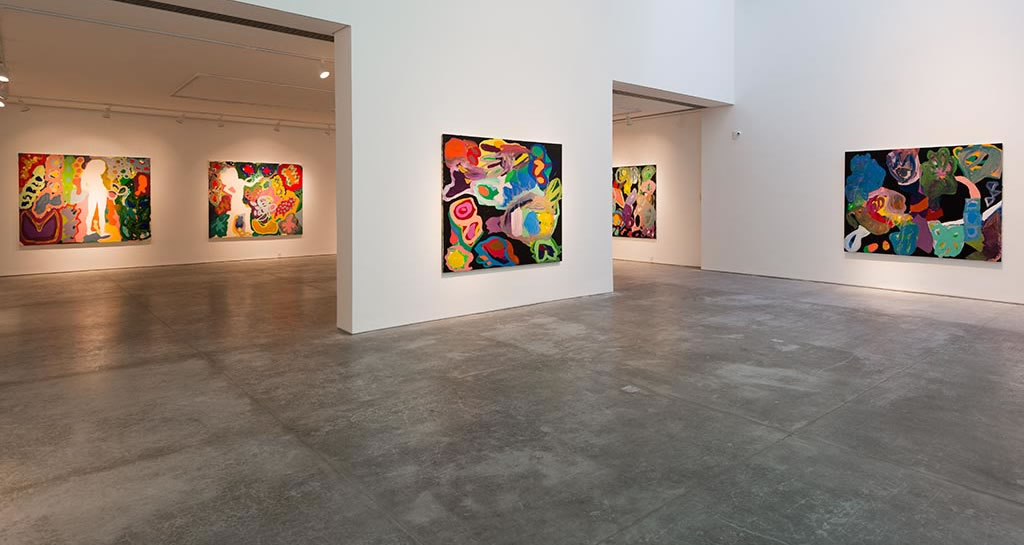
A figure in white, emphasizing a series of pictorial compositions of intense chromatism, demarcates the mystery amidst the exuberant, the ostensive. It pairs up with the leading actor of the video Rastro, in which the character, always seen from behind, walks back home and, in this journey, collects a series of odd, bulky and colorful trinkets that will be added to her garments, in a process that shuffles identity and oddness, alterity and self-centeredness. And the black color that runs off through the surface of other paintings generates frictions and noises in the a priori festive configuration of the canvases, giving less optimistic contours to the works that come to the world.
Maria Lynch’s production is a foreign body in the complex weaving of the Brazilian contemporary art in this beginning of the 21st century, and this is a good thing. For the solo exhibit that is on at Roberto Alban Art Gallery, in Salvador, the Rio-born artist seems to unfold issues already drafted in the country’s history of art. In this line, we may elect the one perceived in Baile à Fantasia (1913), by Rodolfo Chambelland (1879-1967), key work of our modernity, when form and content unite in an intricate way and highlight this spirit of time (at the time, the turn of the 1890’s to the 20th century) that carries, in a more latent or explicit way, melancholy and pessimism. These are feelings that, yes, will indicate that the carnival festivity portrayed has a date to end. It’s more the weight of an Ash Wednesday than the intoxication of the commemorative days. It’s as if the emptied figures in white of Lynch’s new paintings were contemporary re-editions of these old characters, only now staring a rhythmless dance, in fragmented, incomplete and non- fillable environments, even if involved in an alluring colorfulness. Chambelland’s revelers and the women of the canvases with evocative titles - Vácuo, Pode Ser e Nem Tanto, for instance – rhyme anxiety and euphoria, isolation and communion, stiffness and volatility.
In formal terms, the artist’s painting brings a free feature that doesn’t escape from the experimental, something that may bother supporters of a more perfectionist production. The transit through an unsteady zone between the figurative and the abstract and the outstanding versatility of means, since Lynch signs with the same care her pictorial, tridimensional, performance and audio-visual works, helps to include her in a kind of expanded painting, so much seen in circuits abroad and that, around here, sometimes is not very well understood or analyzed.
Thus, echoes of Peter Doig, Cecily Brown and other contemporary names resound in Lynch’s numerous productions, but she doesn’t fail to emphasize her own poetic in different media. It’s possible to relate, for example, the great installation Ocupação Macia (2012), a work the artist made for the Paço Imperial, in Rio, and stands out for the obsessive juxtaposition of toys, dolls and similar in only one room, with recent paintings on which the black paint runs off, like a contaminating element, but that also serves as background and helps in the final composition of the piece. This dubious materiality is highlighted, for example, when the artist leaves the drawing traces in the final configurations of the canvases, blending procedures of drawing and painting, in the simultaneous use of the dense oil and the light acrylic and in the choice of generous gamut, so that the observer really has a physical confrontation with these works.
Lynch likes to face her production as a big collage. It makes sense, to an artist whose work has already been described as “tropical surrealism” – words by Ligia Canongia, referring to the tridimensional pieces of the artist. Because if Dada and surrealism preached the free association in a moment punctuated by the socio-technological, and of other orders, innovations, what to reserve for today’s artist, in such a hybrid, multifaceted and of hyper-circulation universe? Maria Lynch’s mashup places us in the center of this whirlpool. And, in that moment, will we be inebriated or serene?