Forward, in fits and starts
José Augusto Ribeiro
For three and a half decades, Paulo Whitaker has been elaborating a singular system of ideas and production of paintings and drawings. It is not a method, because there are no rules for doing it or a pre-established result to be accomplished. But the artist has instituted, during this period, ethics and economy of his own, which contribute to distinguish his production in the general scene of contemporary art. Whitaker constitutes, for example, a repertoire, in constant development, of repetitive and recurrent shapes and figure – that are multiplied by two, three, half a dozen and even tens of times in a single work, and can also proliferate in different works, carried out over time.
These elements are spirals, rectangles, squares, circles, semi-circles, line segments. These are shapes that resemble wings, clouds, blades or rabbit ears. They are trees, trunks, plants, fruit. They are human heads, busts, birds, horses; schematic drawings, with a single trace, of houses linked by lines of a common path. They are plates, trophies, recipients, and so on...In a Variety that comprehends geometrical shapes, the reproduction of details of architecture and furniture, the representation of beings and objects, without opposing figures to abstractionism. In common, they are simple, direct prints with graphical appeal and tend to produce immediate visual impact. In its development, the work structures, thus, an imagination that is, at the same time, fragmentary and emblematic.
Now, if there is no production method, there are, rather, procedures and principles that make the ways of carrying out this work particular. In the course of his trajectory, Whitaker reached, in fact, peculiar workmanship solutions. Among other reasons, by combining mechanical, automatic operations (and that, despite being manual, would be “cold” for not involving expressiveness), with improvisation, with decisions made instantly without previous plans (in processes of which total freedom is presumed and in which intuition would be, actually, preponderant). From these frictions result works that have a continuity sense, due to the repetition and difference games set between one work and the others, while maintaining the passion of the unpredictable, the qualities of awe and surprise, or of what was made from quick choices, of sudden actions and with the enthusiasm of the exercise, from ready and previously chosen figures.
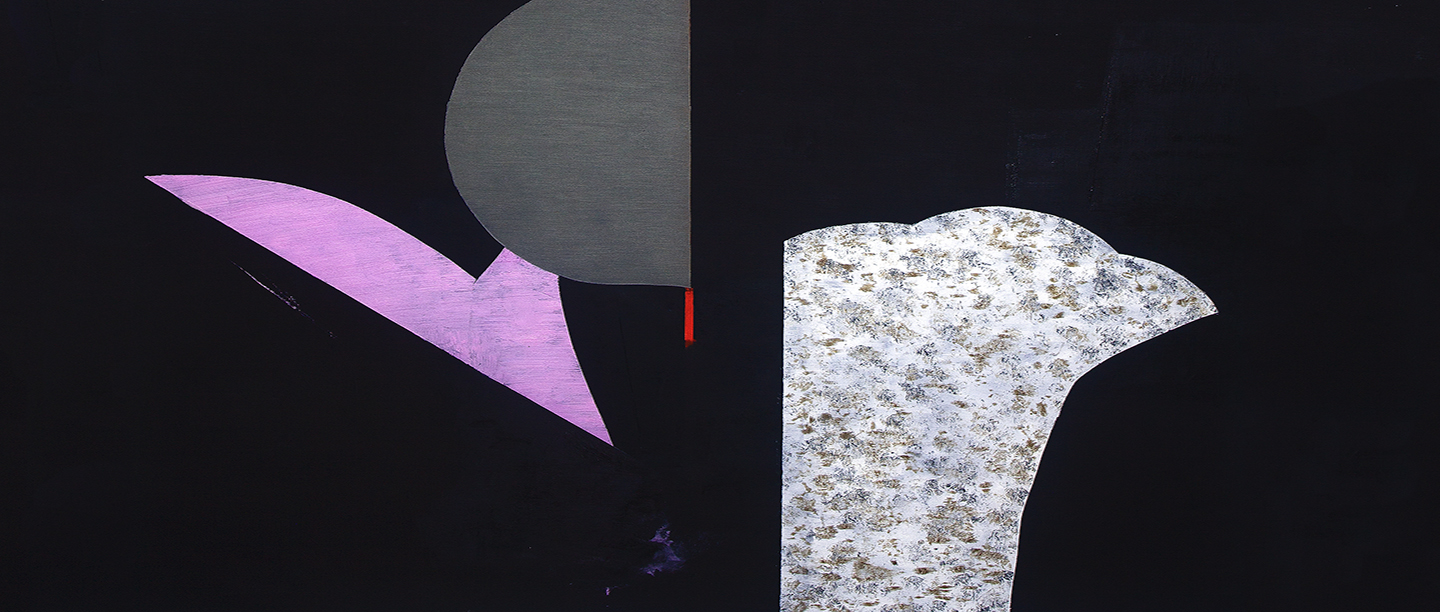
Since the middle of the 1990s, the artist has reproduced a significant part of the elements of his work on canvas and on paper, through stencils. Whitaker cuts the silhouette of these shapes and figures in paper to apply them with paint (or spray, or with the use of paintbrushes) on backgrounds that are, in turn, monochromatic, homogenous and uniform, or spotted, with two or more colors mixed and “scratched” on the support (as in the serigraphy technique). Not rarely, the artist smears paint also on the margins of the stencils to print the contours of these matrixes on the works.
To some degree, it is a machine-like painting – insofar as the artist’s gestures are restricted to the smearing of paint on the stencils, to the transference of shapes to the surface and the filling of that plan. However, despite such mechanisms, this is not a work that seeks precision, the flawless reproduction of ready silhouettes. On the contrary: Whitaker’s paintings and drawings are dirty, irregular, accumulate the signs of process and whatever occurrences. Or better: are dirty and truthful in the exhibition of their facts. The certainties, doubts, the obstinate gestures, but also the ones that inspire hesitation; the categorical and exact movements, the escapes, the leftovers and the actions that will probably be considered “mistakes” (considering that, in this category, there are the involuntary and the deliberate ones), it is all there. Again: it is a work carried out with the cut shapes of the “masks” and in the ardor of a continuous sequence of operations without previous program and, in the end, available for inspection.
It is interesting to note, at this point, how Whitaker’s painting has something of drawing, of the projective character of the sketch, of the quick notes, of something that, ultimately, is still under construction. Specially for the traces and stains left open during the elaboration of the work and that, incorporated to the results, become indexes of the making process – leaving, consequently, the idea that, from these marks, from the sequence of the printing of shapes and figures, it would be possible to reconstitute the complete production of the work, from beginning to end. Similarly, the artist’s drawings exhibit a pictorial intelligence in dealing with colors, in the distribution of their components through the two-dimensional space, etc.
However, both the artist’s paintings and drawings have something (and it is not little) of collage: in the accumulation and disposition of the figures on the surfaces; in the junctions between elements apparently without previous connection, but that are presented linked and interdependent; in the ways that these elements adhere to the work’s surface. It is a bit weird that they are all “contemporary”, that they all come from the same place, produced over a short period, because, up front, they appear to have different origins.
In Whitaker’s work there is, also, something of engraving in the repetition and reproduction of figures. Finally, the logic of production stands out– similar to the construction procedures of a structure, of a sculpture formed by the connection of discontinuous parts – that arises in juxtaposition operations, pilling and balance with which Whitaker organizes his components in some paintings. The artist sets, in these works, structures that tend to be ingenious, that are sometimes brute, however, always elegant and light, laid out in improbable balance and, therefore, apparently risky, virtually unstable, as if at any moment that machinery could crumble.
In the Whitaker’s works gathered for this exhibition, produced since last year, the austerity described above prevails. The paintings presented here substitute the vibration of overlaid and overloaded shapes – characteristic of previous works, carried out between 2010 and the middle of the 2010s – for surfaces with a smaller number of elements, on which the majority of the components is disposed side by side or in juxtaposition. It is common, for instance, that in these works the shapes touch each other, subtly connect by the ends. The elements are placed, in this way, in open and direct relation with the others – autonomous and, at the same time, in contact. Almost as if they were reminding us that the production as a whole conducts its march, thus, by the extremities of language, in order to spread itself to the limit, to approach other knowledges, techniques and solutions – of collage, engraving, serigraphy, sculpture.
But it is painting and not something else. It is drawing and not something else. It is about, still, an impure work, marked by crossings between different languages and an infinity of contaminations. There isn’t a supposed essence to be preserved. And nothing here is intended to be static, homogenous or cohesive. By the way, the title of the exhibition maybe has something to do with it: Solavanco, ou entre o cético e racional e o místico e sensível (Jolt, or between the skeptical and rational and the mystical and sensitive). The wording seems, from the start to not recognize the simple and unmediated transition of these categories of the philosophy field for the debate of art. Later, the refusal seems to dismantle, in a good mood, polarizations that sound rigid and simplistic, like opposing project and improvisation, repetition and surprise, in face of one of these works by Paulo Whitaker – in which, in each appearance, a shape is always a different shape, taking on a variety of positions, thickness, textures, colors...The crossing then continues in fits and starts.