
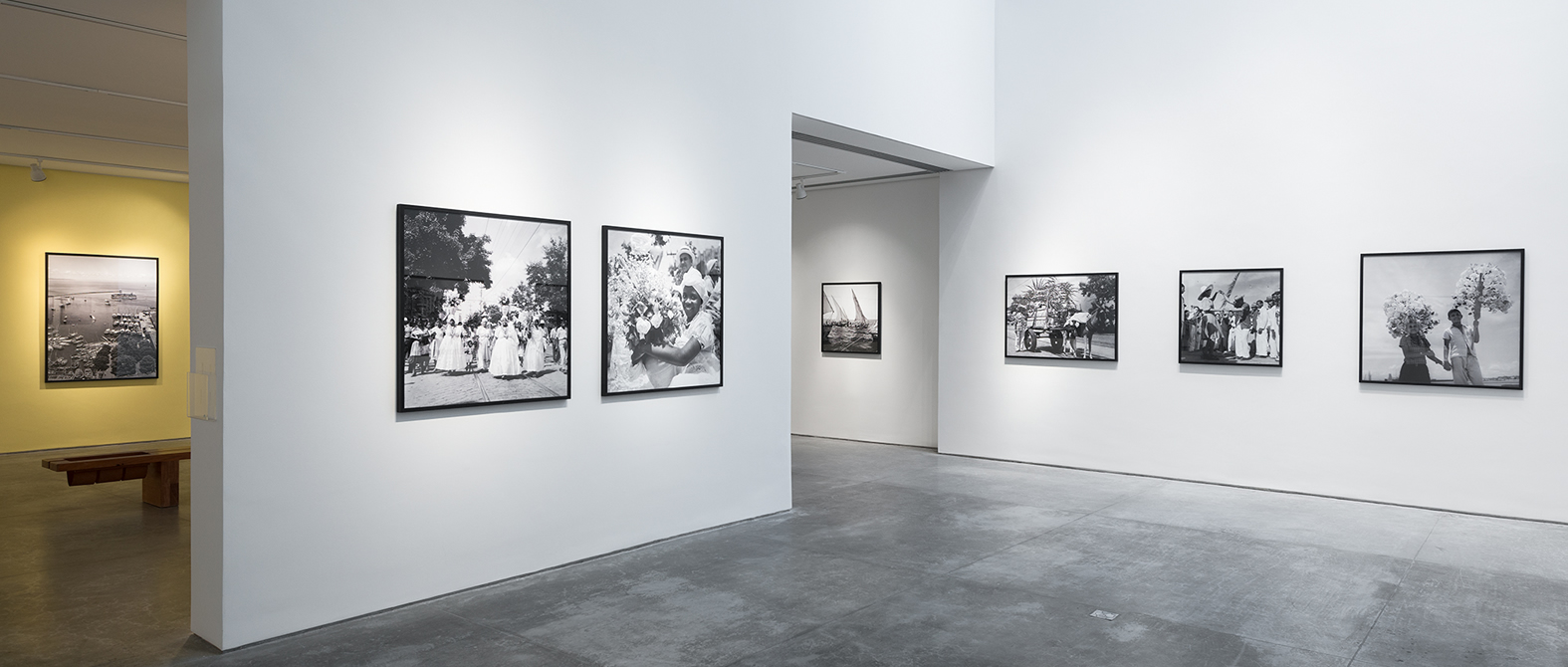
Voltaire Fraga, today (between yesterday and tomorrow)
Dilson Midlej
He loved life, his family and lived to photograph. Born in Salvador, Voltaire Fraga (1912 – 2006) soon discovered the magic of photography and practiced it professionally. Fraga conciliated social photography and personal projects in which is evident his sharp vision and refined sensitiveness through creative compositions and precise technique.
This timely exhibition at Roberto Alban Art Gallery presents part of the photo collection taken between 1930 and 1960; work rich in themes that evoke experiences and displacements of past times. As it is well known, experience is always conditioned to the dimensions of time and place; in this case, the time period is the one of the decades in which Voltaire Fraga worked, while the place is the Bahia of urban scenes whose lives portrayed are now absent, images that denote nostalgic feelings of a city of Salvador that opposes the present days and that conform the uncertain days of tomorrow.
Fraga’s visual narratives challenge the verist belief of the photographic image as a mere register of reality and positivist technical resource exactly due to the affection with which he “harvests” his images and makes them “bloom” impregnated with personality and poetry. They are narratives whose protagonists are anonymous passers-by of the bustling city daily life, vendors, sailors, washerwomen, all of them worthily pictured, in contrast with the poverty and social destitution in which many of them lived. From the images emerge concerns about the transmission of dignifying humanistic values, impregnated in the social roles of the subjects of his pictures. Voltaire Fraga’s vernacular vision highlights, also, the pleasure in daily activities that runs through children playing and festivals. Salvador emerges splendorous in parts or in panoramic views as an affectionate city and it clearly reflects the level of the photographer’s sense of belonging.
Even if his work is classified as belonging to the genre of social documentary photography, it seems to comprehend the attraction and motivation of the shapes, light and textures of the surfaces of the places photographed. In historical terms, by affirming himself as author and exploring the characteristics mentioned, Fraga’s work falls into the modernist context, which means that the sense of image’s meaning is in the realization of an author’s intent, or under their control. Besides, his classification as modernist is confirmed by the appreciation of social types that only started to deserve attention in terms of themes worthily portrayed with the advent of Realism, European artistic movement from the mid-19th century, of significant influence in the development of Western art and photography’s social history.
It is through the observation of the timelessness of these narratives that this exhibition is structured; formed by yesterday’s frameworks that, however, point to possibilities of future developments of the photographic language through other possible “Voltaires Fragas” who may, by the manipulation of the signs of criticality and freedom, constitute future days.
Dilson Midlej
PhD in Visual Arts and Professor of Art History from the Fine Arts School of UFBA, august 2019