
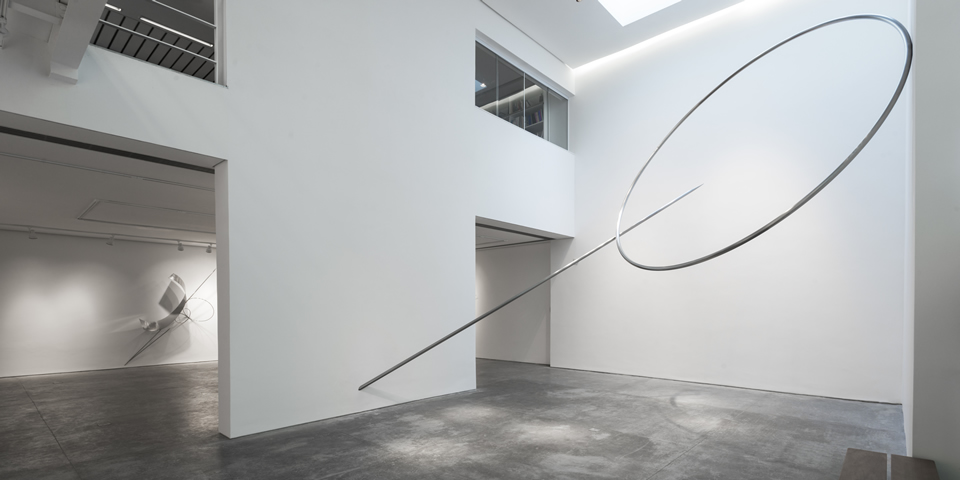
Dancing her Oeuvre or the Writing of Movement Iole de Freitas, Roberto Alban Gallery, Salvador, May 2016
Marc Pottier
A woman, an artist, a Brazilian who dominates space:
First of all, I would like to remember that Iole de Freitas is a woman and an artist. She was married to an artist. She is a Brazilian born in 1945. This statement is far from banal. I cannot help but think of that Lilliputian portrait (as she herself put it when she saw the image) of her in front of the huge sculpture more than five meters high and large that she produced in 1991 in the Morumbi Chapel in São Paulo. Countering the dominant ?phallocentric? tendencies that mentioned Jacques Derrida, including the art world and given also that Iole is an artist who belongs to a generation for which Brazil, despite the creation of the São Paulo Biennial, was still not part of the circuit of art professionals, this photograph managed to sum up the incredible energy and creativity with which she lives. The production of a work could not go ahead, except through her. This photo is one of many. It is enough to leaf through her biography to see how this artist has always seen things in a grandiose and generous manner. She exhibited large airy installation pieces passing through the walls of the host museums. She knew how to render them transparent and frequently breached them the better to develop her work outside. Her latest exhibition at the Rio de Janeiro MAM in 2015/16 suspends her grand-scale drawings (as her sculptures can also be seen as) and reveals to us that new writing of movement that she creates, apparently heedless of the constraints of either of the weight of the materials she employs or the cathedral-like space of the museum. We should recall that the history of the first women?s avant-gardes of the 20th century, principally in Europe and the United States, developed completely independent of the major prevailing art movements. But no plastic arts revolution was foreign to women: photography, video art... they were also a step ahead of men in also investing in dance and performance as a multidisciplinary space. Always in the vanguard of new technologies, they were pioneers of digital art. Women take up the story (again). Ownership of their own brand of modernity and way of inventing their future can be seen from the perspective of the progressive or radical development of the plastic arts, of dance and theater. This favored acts that regarded the body as a work of art. Brazil would have to wait until the late 1960s for the experimental work of Lygia Clark or Lygia Pape.
Iole de Freitas, seems to approach her work in a way that frees us of any militant, sexual, conceptual or immaterial feminist engagement. She has no rage. But there is a strength, a kind of strength that it seems impossible to resist. Iole de Freitas proceeds unbridled, unflappable. While she herself is very much a physical presence, what she demands of her body is wholly metaphorical, subtle, confined to sensations. The body is always present but nevertheless always invisible. This original new writing of movement, of original dance, that she presents us with, these drawing-sculptures as we described them above, are the work of an outstanding sculptor of space, in which she offers us all that she is, ?cashes in? as we would say these days.
Iole reminds us of another great artist, Louise Nevelson:
?I feel that people often fail to take account of the meaning of space. They think that space is something empty. In fact, in our spirit and in our projection of ourselves into this three-dimensional world, space plays an utterly vital role in our existence. Your conception of what you put in a space creates the novelty of a new space. You can see someone entering a room and dominating the space. Space has an ambience and what you put in it colors your thoughts and feelings in some way? In Iole de Freitas, the work dominates the space. But, by dominating it, it involves us in its dance. We have no choice.
Dancing her Work or the Metaphor of Unfixedness?: Almost twenty years of contemporary dance have left an indelible mark on Iole de Freitas?s work. Even though she doesn?t talk literally in terms of dance, it is always present. For me, this is not ?movement? but ?dance?. For Nietzsche, writing was dancing. Dance is a metaphor of thought, a form of writing that struggles to gain freedom. Iole de Freitas, as we have seen, has no limits; she wants absolute freedom. We could also cite Alain Badiou when he writes of ?the metaphor of unfixedness? or the ?intensification? of Paul Valéry. This is precisely what is at play in the work of Iole de Freitas. An inebriation, an intensity of metamorphosis that grants us the power of deliverance and enables us to interpret the world. Iole dances with ideas, she dances with the materials and involves us with her in an explosion of Dionysian life.
The interexchange between artists, dancers and choreographers has been constant since Dada, which wanted to make dance a visible manifestation of life. But, while dance provides nothing in return, no written documents to keep, no paintings to hang on the walls or display in exhibitions, only a single fleeting instant in which people feel alive ? Iole de Freitas in turn, knows how to propose a miracle through her dance. She seizes upon the dancing body as a way of inventing new plastic incarnations. The abstraction of the body is taken to the extreme. She believes in life, in all living forms, in its metaphors, in the ?mobile synthesis? as Stéphane Mallarmé called it, the quintessence of suggestion.
Iole de Freitas knew how to forge new perspectives, mixing cross-cutting themes, new dynamic forms of the real that lead to abstraction. One is reminded of course of Futurist artists, especially Umberto Boccioni. He is the artist who knew how to go further in terms of incorporating everything as way of unifying ?the transformations that the object undergoes as it moves about in relation to the mobile or immobile environment?. Iole is well aware of the effects of this continuity and simultaneity and this kind of abstraction that integrates figure and space.
Some of Iole de Freitas works invariably remind us of another remarkable woman: Loïe Fuller (1862-1928) with her Serpentine dance, in which she disappeared into a long veil as she spun in a clever play of lights and mirrors. She invented the first kinetic and light sculpture, a great artist of color and line, a precursor of women?s art. This has nothing to do with the dance of the seven veils ? that divinized striptease of feminine seduction ? since Loïe Fuller?s veil serves as a sculptural support. She geometrically unfolds all the transformations, undulations and deformations that it undergoes in her movement, through the air and the surrounding space.
In Iole, it is up to the viewer to imagine the possible transformations. Her works inhabit the imperceptible movement of the imagination of the observers. Unconsciously, we continue her dance in our own heads and in our own movements as we move around her sculptures or follow them with our eyes. We are back to Boccioni: ?the idea of the sculptural object becoming the plastic result of the object and the environment? prolongs a body in the ray of light that strikes it, a void penetrating the plenitude that passes before it. I can do this by uniting the atmospheric blocks with more concrete elements of reality. The figure closed in on its traditional line must be completely forgotten and replaced with the figure as the heart of the plastic meanings of the space? (1 st Futurist Exhibition 1913). Iole de Freitas extracts the rhythms and forms of life. Like Tommaso Marinetti in his manifesto of futurist dance, she knows how to use gestures to imitate the movements of machines, assiduously courts the various materials that she employs the better still to imagine the fusion of human being and environment, to eventually achieve the metallic quality of futurist dance!
Finally, the works of 1992 presented in this exhibition are somewhat reminiscent of Hélio Oiticicas Parangolés. The experimentations of the artistic avant-garde in the 1950s to 70s were marked around the world by the incursion of the body into the traditions of visual art. The Parangolés, combining the aristocratic extravagance of Renaissance draperies with the bricolage of inhabitants of the Mangueira favela in Rio de Janeiro, amount to an outstanding invitation to stage a dance and reflect amidst an accumulation of disparate materials in search of a space that allows the painting to be encroached upon. Iole de Freitass mise en scène is cerebral. The interaction is that of the imagination, that of the metaphor of unfixedness. So, lets dance!
Marc Pottier Rio de Janeiro, March 2016.