
Evoking the name of a place, a neighborhood, a state, a nation to organize artistic expressions constitutes a political strategy. Places exist beyond any definitions, maps, borders. We only need to say where we come from to generate some kind of negotiation. At the same time, denying the representation of an identity part to the ambits of Art may hinder some products’ process of insertion in the greater scope which, for example, we name Brazilian art. The nation, as Homi Bhabha stated, suits us to fill gaps, occupy spaces.
The “place fantasy”, as any other fantasy, is used to highlight the distinctive, highlighted, ornamented features and substitute the experience of place, the one that is not reduced to images, songs, manners. Brazil and Bahia were invented as fantasy. With all endeavor for epical narratives, we need to say what a place is, build it as affiliation strategy, as much as not everyone identifies themselves or are identified. At the same time, what seems libertarian may become bond, tic, and joke if we don’t allow space for innovation, renewal, reinventions.
From the middle of the 1980s and with frank intensification in the 1990s, the naming of places formerly marginalized was showing in the main museums and art galleries. Descriptions were added to such fantasies: Africa after modernism, the Third World, Latin America, the Islam. The exhibits Primitivismo na arte do século XX, Magiciens de La Terre, Cocido y Crud, 24a Bienal de São Paulo (Anthropophagy) showed that we needed to include other voices, other places, other ways of seeing and producing contemporary art. Thinking the place is reviewing, primarily, the formalist and ethno-centered traces, from questions and from indentifying conceptual keys, like anthropophagy.
The exhibit Bahia, contemporânea Bahia (Bahia, contemporary Bahia), at Roberto Alban Art Gallery, follows this desire in a much more specific way: thinking the contemporary production, from artists that work from Bahia. We don’t intend to assert specific features, manners or accents. But activate the presence of a multicultural eye that also crosses this production, making the history of each selected artist connect in a greater or lesser level to the historical influxes: Almandrade had contact with Helio Oiticica and Paulo Brusky, Willyams Martins started to produce concurrently with events such as the exhibition that launched painters of the Generation 80, Lara Viana studied in England in the academic centers that formed Damien Hirst, Josilton Tom had contact with modernists from Bahia and with the long years of the important Salão da Bahia (Bahia Show). But history is renewed and presents Március Kaoru’s productions, thought from family memories, the production of a Japanese descendant in Salvador, Vinícius S.A. that bravely expands the appropriation of domestic appliances for the big installations and Fábio Magalhães, whose painting activates and dissimulates possible adherences to images from Bahia. Meanwhile, we have the surprise of being able to count on a photographic interest, at the same time installation and performance oriented by Rosa Bunchaft that makes photography an immersive experience.
The formation of these artists is of such amplitude that it must be noticed. Some start from the experience with schools outside Bahia and Brazil, others present the contact with the independent events, most of the times around exhibits, groups, advisors.
The art system in Brazil, today, is still in progress. Therefore, an exhibition like the one we are dedicated to hold in a commercial gallery that, for the city of Salvador, will have the mission of making up for part of the institutional gaps. Hans Belting had warned us that at the moment the museums became traditionalist, the galleries would open to bold propositions; we only have to remember the exhibits O vazio, by Yves Klein, and O cheio, by Arman, respectively in 1958 and 1960, at Iris Clert Gallery, in Paris.
It becomes necessary also to update and see again the long lasting modernism that still predominates in a big part of Brazil. Yes, it’s time to think about the contemporary, as problematic as the term is, so that we can recode materials and methods, poetics and images, opening the way for those whose adventure.
Március Kaoru
Március Kaoru’s work highlights the strength of an artist dedicated to the doing. Not the one the foresees arrival places, repetitions, but the chimerical doing, reuniting heteroclite pieces, removing the raw material and processing it for amplified adaptations. Thus, we see images of his eastern heritage coadunate with an air, a spirit among the popular toys and the oriental altars, inherited from father to son. In another sense, the use of bamboo allows painting, engraving, copying situations as if we were dealing with millennium-old manners and the mere excesses of a post-industrial society.
Lara Viana
Lara Viana’s painting observes tradition as symptom, as mote to be quoted. Thus, we see refined studies of poses, figures, pallets that sometimes we find in the palatial porcelain floor, sometimes we experience in Rococo paintings. The affectation of gestures, hugs, kisses shatters when we notice situations that don’t complete themselves. What was image, portrait becomes ghost. We know that ghosts are incarnations of the nuclear idea of painting itself: soaking a linen cloth so that we believe in flowers, china, bodies that have never been there. With this, Lara potentiates with great originality an imagery experience, at the same time abstract and phenomenological.
Vinícius S. A.
The observation of the light is one of the most recurrent ways of Art. From the Baroque’s theatricality to the machine resources of the photographic image, Art surrenders to the luminous splendor. Light activates in us spheres of religion, science, intimacy. Vínicius engages in the exercises of light and in the selection of materialities (earth, dust, rocks) to propose installation situations. Starting from both religious facts (tears) and the violence of the panopticon (security cameras), Vínicius relates disposable objects and gadgets. Machines and desire actions are created to get to the core of the structures, like someone that is interested in an internal, subcutaneous, epithelial aesthetics.
Willyams Martins
Willyams Martins researches the skins of architecture. Architecture is and will be more and more the skin of places. Today, it becomes necessary to think about sustainability, the use of solar energy and rain water. And architecture turns into skin. Wylliams thinks, first of all, that we need to preserve the beauty of what is engraved, subversively, on the walls of the city, in prisons. Facts that gave him the nickname “graffiti thief”, since the artist invented a technique to apply resin to the walls and remove the marks. Thinking the wall and its inscriptions, painting as skin, makes Wylliams an artist interested in preserving the memory, stealing what is bound to disappear as soon as it emerges.
Almandrade
The so acclaimed dematerialization of Art, from the 1960s, reestablished the way artists dealt with the permanence and origin of materials. Thus, the possibility of using mundane shapes and objects suited circulation means of the artistic experiences, in the so called postal art, for example. Almandrade is an artist that activates these historical interests, greatly develops the materiality of ordinary, simple origin, to think messages, words that become visual-poems. Member of the generation that used art as watchword, Almandrade stayed attentive to the semantic fields, beyond visuality, producing situations that are, mainly, language games.
Josilton Tom
Wood in Brazilian sculpture opens an important chapter to make us realize the bond and the addressing of the matter to the memory of a place. Used in fair boxes and in the most noble altars and society salons, wood may create distinctive genealogies. Josilton Tom seems to be interested in all the amplitude of this matter: the smell, the nobility, the muttness. And thus, gets hold of new, used, demolition or found woods. His pieces bring Brancusi like effects, simulating parts of the body, and schemes like diagrams. From a simple gesture on wire, Josilton creates lines, segments of lines, knots, encounters, observing extensions that become tridimensional like threads in almost biological drawings.
Fábio Magalhães
Fábio Magalhães’ painting brings an evident seduction: the possibility of a figurative representation that is closer to the photographic realism. But Fábio subverts this initial seduction bringing relations and references of art history together with observations about daily practices. In the ambit of Brazilian traditions, Magalhães works as a slaughter man, character destined to butch animals. At the same time, slaughtered animals are in the history of painting, like Rembrandt’s Slaughtered Ox. Fábio’s paintings powerfully create distinctive affiliations. Of the memento mori, Magalhães mocks the certainty of death with the seduction of a kiss, but, above all, with the perplexity of a being facing Narcissus’ lake.
Rosa Bunchaft
Rosa Bunchaft observes the photographic activity as a dilated mission. She makes photographing a performative attitude. Rosa observes not only what will be photographed, but also the surroundings; updates the image, thinking about it over time. Calculates the expansion of photography with her own body; creates long expositions so that photography works not only as a definitive click, but as possibility of time enlargement, change in the landscape, alteration of light. With the use of the pinhole, Rosa creates another configuration, using places of observation, slits, windows, bastions, belvederes to create images in ample linear measures. Thus, recoding what we formerly called panoramic image.
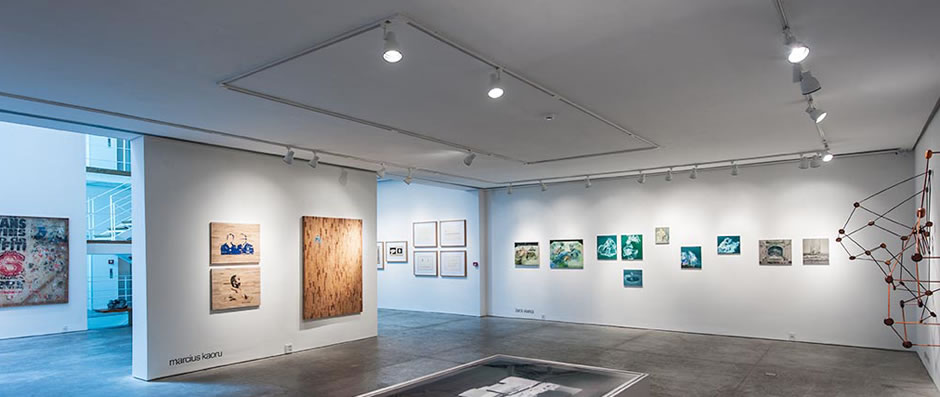
Bahia, Contemporânea Bahia
Coletiva
Exhibition29/May to 12/July, 2014