
Bahia, contemporary Bahia
Evoking the name of a place, a neighborhood, a state, a nation to organize artistic expressions constitutes a political strategy. Places exist beyond any definitions, maps, borders. We only need to say where we come from to generate some kind of negotiation. At the same time, denying the representation of an identity part to the ambits of Art may hinder some products’ process of insertion in the greater scope which, for example, we name Brazilian art. The nation, as Homi Bhabha stated, suits us to fill gaps, occupy spaces.
The “place fantasy”, as any other fantasy, is used to highlight the distinctive, highlighted, ornamented features and substitute the experience of place, the one that is not reduced to images, songs, manners. Brazil and Bahia were invented as fantasy. With all endeavor for epical narratives, we need to say what a place is, build it as affiliation strategy, as much as not everyone identifies themselves or are identified. At the same time, what seems libertarian may become bond, tic, and joke if we don’t allow space for innovation, renewal, reinventions.
From the middle of the 1980s and with frank intensification in the 1990s, the naming of places formerly marginalized was showing in the main museums and art galleries. Descriptions were added to such fantasies: Africa after modernism, the Third World, Latin America, the Islam. The exhibits Primitivismo na arte do século XX, Magiciens de La Terre, Cocido y Crud, 24a Bienal de São Paulo (Anthropophagy) showed that we needed to include other voices, other places, other ways of seeing and producing contemporary art. Thinking the place is reviewing, primarily, the formalist and ethno-centered traces, from questions and from indentifying conceptual keys, like anthropophagy.
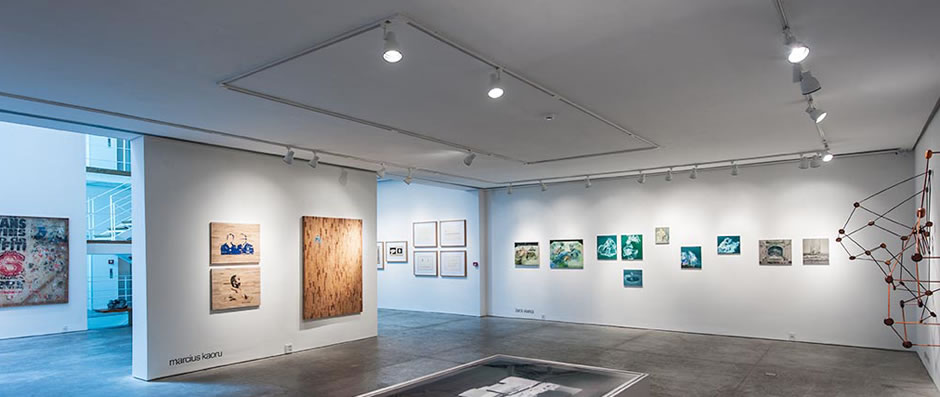
The exhibit Bahia, contemporânea Bahia (Bahia, contemporary Bahia), at Roberto Alban Art Gallery, follows this desire in a much more specific way: thinking the contemporary production, from artists that work from Bahia. We don’t intend to assert specific features, manners or accents. But activate the presence of a multicultural eye that also crosses this production, making the history of each selected artist connect in a greater or lesser level to the historical influxes: Almandrade had contact with Helio Oiticica and Paulo Brusky, Willyams Martins started to produce concurrently with events such as the exhibition that launched painters of the Generation 80, Lara Viana studied in England in the academic centers that formed Damien Hirst, Josilton Tom had contact with modernists from Bahia and with the long years of the important Salão da Bahia (Bahia Show). But history is renewed and presents Március Kaoru’s productions, thought from family memories, the production of a Japanese descendant in Salvador, Vinícius S.A. that bravely expands the appropriation of domestic appliances for the big installations and Fábio Magalhães, whose painting activates and dissimulates possible adherences to images from Bahia. Meanwhile, we have the surprise of being able to count on a photographic interest, at the same time installation and performance oriented by Rosa Bunchaft that makes photography an immersive experience.
The formation of these artists is of such amplitude that it must be noticed. Some start from the experience with schools outside Bahia and Brazil, others present the contact with the independent events, most of the times around exhibits, groups, advisors.
The art system in Brazil, today, is still in progress. Therefore, an exhibition like the one we are dedicated to hold in a commercial gallery that, for the city of Salvador, will have the mission of making up for part of the institutional gaps. Hans Belting had warned us that at the moment the museums became traditionalist, the galleries would open to bold propositions; we only have to remember the exhibits O vazio, by Yves Klein, and O cheio, by Arman, respectively in 1958 and 1960, at Iris Clert Gallery, in Paris.
It becomes necessary also to update and see again the long lasting modernism that still predominates in a big part of Brazil. Yes, it’s time to think about the contemporary, as problematic as the term is, so that we can recode materials and methods, poetics and images, opening the way for those whose adventure.