
On the visuality of paradoxical worlds
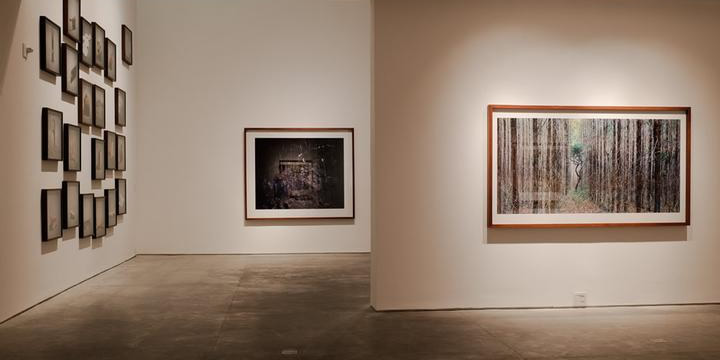
Pedro David, in his current exhibition Espiral Contínua, offers us the spiral’s metaphor. Didi-Huberman, in dealing with Guiseppe Penone’s work, explains to us that the spiral, the “coil” happens when the “space of our familiar visibility is distorted” and turns into a strange, paradoxical place. With the series Rota Raiz, Madeira de Lei, Terra Vermelha and Coisas caem do Céu, the artist believes to accomplish the same sensation of the spiral, acting from the inside to the outside and vice-versa. Therefore, in the photos, we face the effects of the spiral, the distortion, the inner side of appearances, the visuality of unknown worlds, even when looking at daily landscapes: earth, a crop, the walls of an apartment, the floor.
Texture and light are highlighted in the photographer’s observation. Pedro gives special attention to the uncommon luminosity of a house façade in contrast with the moonlight. In another occasion, the worn-out of a sacred image or of an antique map gives meaning to the past and to the obsolescence of the impressions and dyeing. The contrast between large plastic covers, sometimes metallic, and the landscape generates sensations that are almost epic, monumental, in face of more than mundane situations. Inside the waiting rooms, in the corridors of cheap hotels, color and texture acquire and offer meanings to the work of the days, human habits that in the resolution of immediate necessities generate aesthetic solutions.
These relationships between the interior and the exterior are evident when the artist places himself before nature, the wood that seems like an intruder in the regularity of the eucalyptus plantations. But, opposite to appearances, they are solitaire trees, native survivals, fighting for permanence amid the intrusion of the eucalyptus fields that change the ecosystem. Pedro, then, reflects on the “sertão” and its potential invaders, registering the epilogue of these landscapes.
The landscape, in Pedro David’s photography, deals with the threats of the outside. The open roads and the exploration bring the first contradictions. The trails, the routes are, concomitantly, the possibility of access – like the camera to photographer’s eye – but the beginning of the speculation that, if unrestrained, generates annihilation. Image and destruction, here, enhance David’s art with beauty and denunciation. Rota Raiz shows the confrontation between the artist’s place of affection, Mina Gerais’ inland, the reminiscences lived and imagined from visits and the paternal narrative.
The inside, in the photographer’s images, is elaborated as in Ingmar Bergman, where, in the locked home, live pain, anxiety, melancholy and a gleam of light for happiness, the come-to-be of days. Imagining what the father brings, observing the mother’s interest. Pedro David lives the character of the boy photographer sharpened by the elusive look before what is unsuspected.
The wholeness of the father that goes far away, the fear of him not returning, the inaccessibility of the man that reflects and may be embarked, satisfied with the vastness of nature. David’s photography tries to capture these immense, lonely and stiff instants. The river. The father, nature, reality, what is never reached, as Guimarães Rosa knew so well. And, at the same time, when he returns, he brings the experiences of the deep, the interior, where nothing of the civilization can scare, because, in his eyes he had access to the unpredictably of the sky, the incarnated of the earth. And Pedro, even so, tells me: “(…) he spent long periods of time working in the north of Minas Gerais, and came back full of stories and presents.”
Therefore, here, we deal with Pedro’s trips, from the inside and the outside, the openness. The dreams are mentioned, narcissistic experience, for Freud, but, on the other hand, grief as a reaction of loss can be perceived; less paralyzing than creative, the experience of grief, allied to one of the sensations of melancholy, generates the awareness that “the object loved no longer exists, demanding all libido to be withdraw from its connections with that object”. Thus, in series like Terra Vermelha, Pedro David keeps himself desiring, “libidinal”, in Freud’s words, since, in face of loss, photography substitutes the lost lands, exploited in earthmovings, by a hallucination: looking closely at what is left. The lands, now, acquire a more archeological meaning, as if it was possible to look for treasures. Not necessarily the opulence of capitalist value, but the value of the leftovers, of what is regarded with little interest.
Grief is also present in what is inserted in exceeding products, as we find strange some things in Coisas Caem do Céu. From the observation of what fell in his utility room, the photographer clicked the anonymous garbage, which falls from the sky. Dried fruit, last extensions of the trees of daily habits, rests of plastic material, silk stockings, false casings that intend to retain the moment, expand the duration of desire, preserve the life of what was industrially processed. And afterwards, in the extension of time, the will to discard, after the desire is fulfilled. But some of such wrappings don’t decompose, nor take on a natural position in the continuous spiral of life, becoming lasting garbage.
In the sensation of entering in spirals and finding for the first time what had already been imagined, Pedro David reveals the new presence of a landscape of the memory, digs up, brings to light, looks at the light with an “unsettling strangeness”