
Fragments of a pictorial discourse
Mario Gioia
Attesting the vigor of a visual language nowadays seems to be a task that borders anachronism. After all, in multifaceted times, of aspired plurality and hyper-circulation in a variety of scopes, it would be natural that each medium had its specificities clear and in sight without much effort. However, in the real and inflamed world, a desired relationship between supports (to use a terminology that isn´t much used today) in the present visuality sometimes resembles a utopic data, other times seems almost improbable. However, we want to resist and go against the common sense (which doesn’t cease to lie in wait for Arts, it’s worth pointing out).
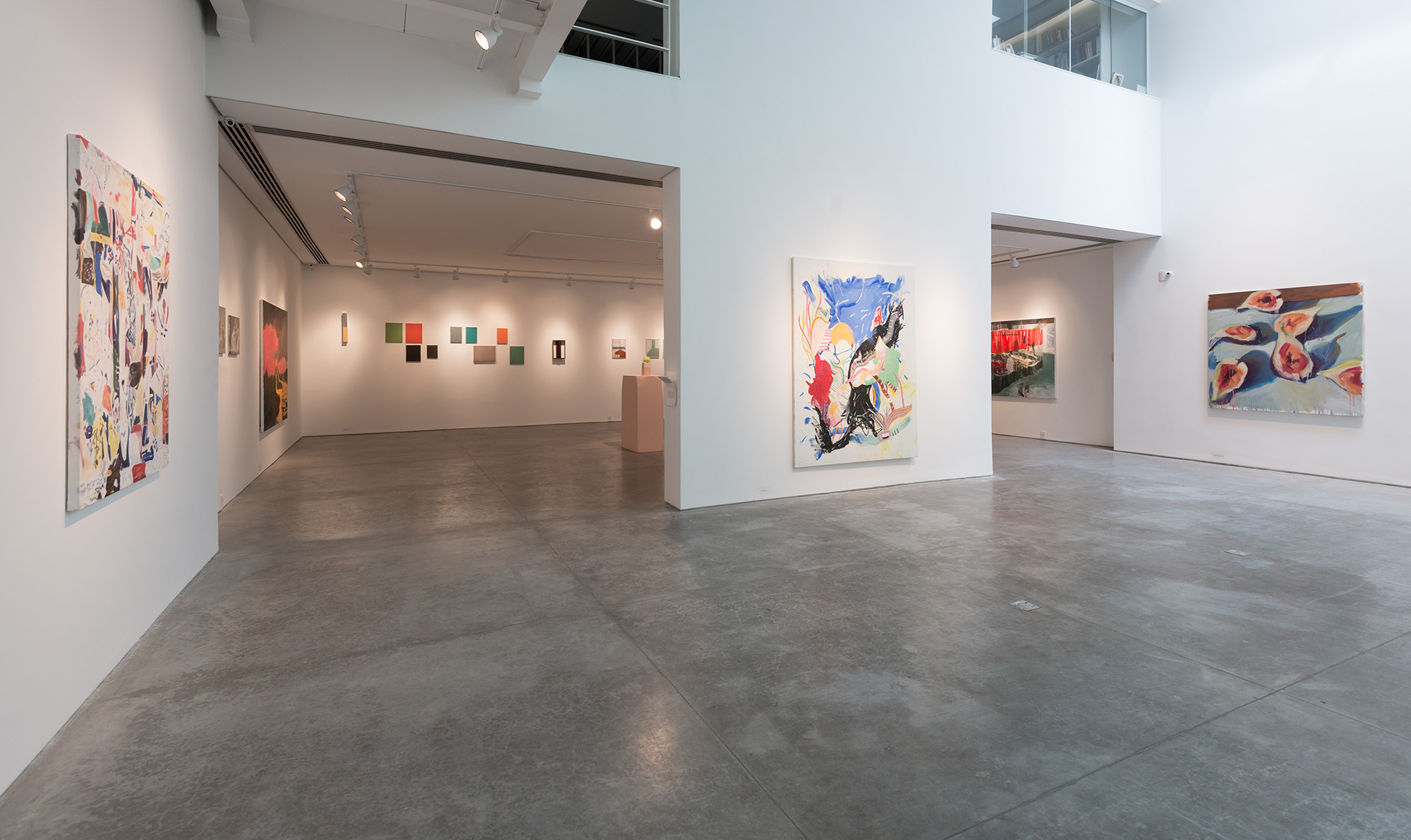
Fragmentos de um discurso pictórico1 also affirms itself as a group exhibition that displays the works of 13 artists of different generations, researches and approaches that is very much based on the attributes that each work generates. And, gathered in this cutting, such works may provoke situations, links and relationships that formerly weren’t so easily presented, now acquiring a new context, other surroundings and more perspectives and looks.
It should also be pointed out that the curatorship has been following attentively for some time the paths of Ana Elisa Egreja, Antonio Lee, Cela Luz, David Magila, Eloá Carvalho, Fabio Flaks, Fabio Miguez, Felipe Góes, Giulia Bianchi, João Gonçalves (João GG), Lara Viana, Ricardo van Steen and Sérgio Sister. And, yes, there are traces of affection, familiarity and admiration in these choices, always loaded with subjectivity. A group exhibition also allows exchanges that escape the market and the instantaneous, building nets, transformations and contaminations repeatedly fruitful. An exhibition is certainly a witness of its time. Thus, a relevant personal data is that, even young, it was decisive to follow in some way the celebrated generation 80, known as the one of painting, closely in its developments in the following decade – a period that also rejected it with some strength – and, later, realize the dialogue that exists between the veterans of those times and emerging artists of an extended field that became known as collective 2000 and Eight. “I claim an experimental statute for my work”2, argued, with reason, Miguez, in face of some prejudice from institutional circles in relation to the pictorial, back in 2009. Today, after innumerous follow-ups of artists throughout many regions of the country, panels, shows and similar initiative, without mentioning the production that comes from the courses of visual arts (in Brazil and abroad), it’s not fallacious to say that painting lives, and well, in our circuit3. In face of the photographic, video, graphic, performative, printed and the countless hybridisms between today’s developed media, painting – traditional, impure, free, installational, wild, expanded, of immersive experiences, digital etc – keeps boasting its seductive doing, in places so severe or chaotic like an artist’s atelier, in more disciplined or less lasting rhythms, in more ordained or intuitive ways, among paintbrushes, color fields, light, pallets, pantones, pixels, hands and minds.
1. The title was formerly used by the author in a text in VÁRIOS. Bettina Vaz Guimarães. Santiago de Compostela, Dardo, 2012, p. 12-16, and is inspired in A Lover's Discourse: Fragments by Roland Barthes (1915-1980). 2. GIOIA, Mario e MARTÍ, Silas. Tinta fresca. Folha de S.Paulo, caderno Mais, 23.ago.2009, p.E4 3. The author thanks the interlocution of young critics, curators and artists that were responsible for exhibitions with similar scopes, like Fernanda Lopes (Sorria!, Rio de Janeiro, 2017), Raphael Fonseca (Figura Humana, Rio de Janeiro, 2014) and Bruno Miguel (A luz que vela o corpo é a mesma que revela a tela, Rio de Janeiro, 2017).
Mario Gioia (São Paulo, 1974) Independent curator, he graduated from the ECA-USP (School of Communications and Arts of the University of São Paulo) and has been part of the group of critics of the Paço das Artes since 2011, institution where he performed the critic follow-up of Luz Vermelha (2015), by Fabio Flaks, Black Market (2012), by Paulo Almeida, and A Riscar (2011), by Daniela Seixas. He was guest critic from 2013 to 2015 of the CCSP’s Exhibition Program (Centro Cultural São Paulo) and was, in the same institution, part of the group of critics of the Photography Program 2012. In 2015, at CCSP, he was the curator of Ter lugar para ser, group exhibition with 12 artists about the relationships between architecture and visual arts. He has already been the curator of exhibitions in cities such as Brasília (Decifrações, Espaço Ecco, 2014), Porto Alegre (Ao Sul, Paisagens, Bolsa de Arte, 2013) and Rio de Janeiro (Arcádia, CGaleria, 2016). He contributes with art periodicals like Select and was a reporter and writer of visual arts and architecture of Folha de S.Paulo from 2005 to 2009. From 2011 to 2016, he coordinated the project Zip'Up, at Zipper Galeria, for the exhibition of new artists and new projects in curatorship. At the art fair ArtLima 2017, he signed the curatorship of the special section of CAP Brasil, named Sul-Sur.