
“There are other urgencies, especially related to this transition moment in which we live, to this idea that things can’t, but should change. We don’t know exactly where to go, but we know that a rupture is necessary. The frustration we experience has to do with the impossibility of projecting the future. The idea that consumerism and materialism don’t fulfill human desires.”
The quote above is by the curator of the 31st São Paulo Biennial, the Irishman Charles Esche, and refers to the current situation of the art that shouldn’t frustrate itself or be subjected to the fact that what rules us in contemporary life are consumerism and materialism. He incites us to change. We live in a world where prices are attached to things; a disenchanted world where religion, which is one of the pillars of mankind, became merchandise and doesn’t differ from a paid session of show business. In society, which has also lost its ideology, reigns the triumphant consumerism. Everything becomes goods, including human relations and art. You are what you consume and art responds to it and uses this distinction. We are to the Market what we consume and in the art world you are important for what you sell, for your influence in sales and, mainly, for what you buy.
Being and having.
The art that reflects its time doesn’t escape this current condition of merchandise, even as art that rebels against this condition and makes its self-critic seeking to differentiate itself from all this. This critical segment would also be within the “acceptable” and “negotiable” conformity of the market. There are many artists that work with these conflicting issues. But the artistic contestation became just one more style.
Art was turned into a kind of commodity, a mere product; simple merchandise. It’s not easy for the artist to face this condition for their art, because, inevitably, they have also surrendered to the market. There seem to be no way out from this insolent situation of the market. The priced art became a financial investment option completely inserted in this logic of consume that marks the world today. But as investment it’s meant only for the few that understand this “market”. A system full of whims and tricks. With the growing valorization of art also grew the interest of the people that crowd the museums to check out these valuable works of art, worth hundreds of millions of dollars. This change of statute would have democratized the access and altered the way the public enjoy art, which starts to be mediated by the question “How much is this painting on the museum’s wall worth?” Thereby, there are today artists that work explicitly to become brands and attend this market that has its place in the innumerous fairs that emerge throughout the planet, imposing a crazy schedule to gallerists, demanding these professionals to travel with a frequency never seen before in the art market.
Thus, making or talking about art today seem banal if not an aggression to common sense in face of the emergencies of the contemporary society, in which consuming became the order of the day; it started to identify us, actually. In the jargon of politics, market and economy, we became simply “consumers”. We’re no longer citizens, public or people but just consumers. From the consumers of shopping malls to the consumers of culture; we’re inhabited by the merchandise. “If they make me desire to consume, let me consume”. It’s more or less what our society mindlessly chants.
In the context we live, the work of the artist Luiz Hermano wants to point at this emergency, the fact that consumerism and materialism do not fulfill our small desires or the greater needs of humanity. On the contrary, they’re responsible for the anxiety and frustrations that permeate our society. These are the issues present in the approach of his most recent sculptures.
These sculptures are more like installations that break the artistic ideal than sculpture according to the canons of art in force until a short time ago when the notion of Fine Arts prevailed.
The sculptures and installations by Luiz Hermano are very far from this ideal. The ideal of sculpture defined by Giorgio Vasari, in the book Vidas dos Artistas, edited and published for the first time in 1550, in Florence, Italy. The concepts defended by the Italian historian sought the full form (perfect and pure) in which good sculpting (for his time) would have to be composed of parts considered perfect, that is, a good sculpture would be the one that was the result of an art that would remove the superfluous of the material worked. It would reduce this material to the shape of the body that was designed in the artist’s mind. The artist for their turn should bear in mind that all figures, of any kind, either carved in marble, casted in bronze or made of stucco or wood, would need to be major, in such a way that, moving around them, it would be possible to see them from every side to be called perfect sculptures.²
This is not the case of Luiz Hermano’s sculptures that are better defined as sculptural installations that emerge from the floor and go up the wall and have nothing of perfect. The defects, the flaws of the artisan work, made by his own hands and chance, are incorporated to his sculptural pieces.
On the contrary, the classical idea of sculpture doesn’t apply to Luiz Hermano. There’s no search for perfection in his works that are “manual”. Imperfection is an integrant part of his work with pieces that sometimes are on the floor and sometimes end up on the wall. They have an “air” of precariousness, of badly done even. The elements that compose them are industrialized materials following the standards of the ideal of minimalist sculptures. Clearly, without the rigor seen in those works made of materials taken from their seriation to acquire the full sculptural form in their isolation in the exhibition space, and without the intervention of the human hand to give them shape. The minimalist sculptures are borrowed from the industrial seriation to become unique objects when decontextualized from their purpose, their functionality.
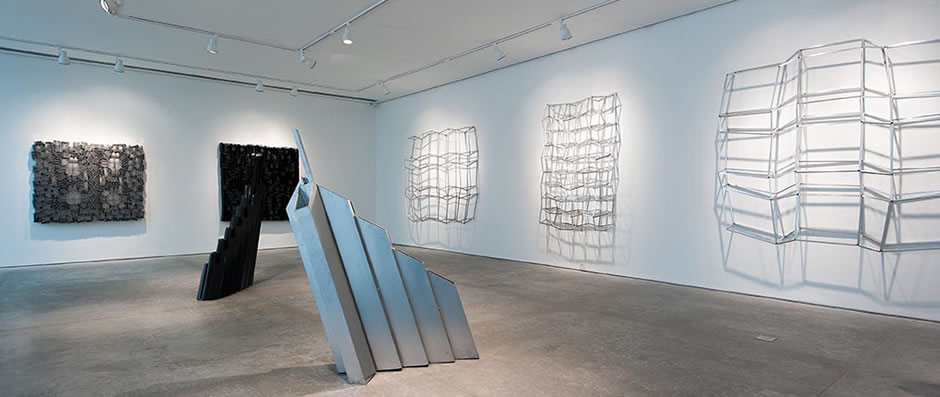
In Luiz Hermano’s sculptures and installations what we see are industrialized materials such as capacitors, plastic toys, harrows, animal miniatures, diverse plastic materials like sponges, and the metal wires he uses to build his wired and imperfect treads. Made by hand they’re grouped and tied up with wires. They’re also built with weld. The result are treads that resemble the traditional cobogós (hollow walls) very much used in Brazilian modern architecture. These structures, as in the work Gato e Rato, of 2012, made in painted aluminum, add humor to the Brazilian constructive art.
There are also the Icebergs. Sculptures that are made of shaped aluminum, material of recurrent use in his work. They’re cut and welded in a way to build geometrical volumes that resemble the shapes of the sculptures by the Italian artist Umberto Boccioni (1882 – 1916), that were simply called “Unique Forms of Continuity in Space”. These sculptures by Luiz Hermano are inspired in Rio’s landscape with its mountains and that resemble also the large masses of ice that drift in the planet’s poles.
In his sculptures the small letters, the color lights, the sounds, real and imagined in the silence of his installations and, more recently, the miniature supermarket trolleys made in China. This toy or decorative object is the element used in the most recent sculptural construction.
It’s not known exactly the purpose of these trolleys, whether they are toys or decorative objects. They seem to be useless objects.
When bringing these trolleys to his work in a seriated way, Luiz Hermano gives them a symbolic load when gathering them by their frames, creating shapes and organic sculptural situations that go on the wall. The artist wants to add to these vigorous articulations a critic of the situation of our contemporary society, discussed in the beginning of this text; a consumerist and individualist society, ruled by money and material goods.
The design of these supermarket trolleys became the symbol and indicator of purchase on the internet sale sites. They work as icons to mark the place where the products bought are accumulated. In a way, they represent our consumerist anxiety and the unrestrained desire to buy and buy. In the end, they became the symbol of the consumerism that rages the contemporary society. Consuming is a new way to interact in the 21st century. The shopping centers are the new agoras of the contemporary cities in countries like Brazil, China and the United States of America. The central installation that dominates the lobby of the gallery made of actual trolleys, a spine to support the exhibition, criticizes “violently” the unrestrained consumerism that rules and bewilders humanity in these cathedrals of our time.
The accumulation of these trolleys on the walls of the exhibition room reminds us of the works of artists like the French Arman (Arman Pierre Fernandez, 1928 - 2005) and the Brazilians Bispo do Rosário ( 1911 - 1989) and José Leonilson (1957 - 1993) that had in common in their artistic processes, collecting and grouping objects of daily life. This way, Luiz Hermano expresses his desire to reorder the world by accumulating, cataloguing and reorganizing the most diverse industrialized objects. Later, he takes this accumulated matter to his works linking, tying and filing them in his work.
These materials emerge and are organized in a way to provoke and evoke existential issues. The trolleys cause strangeness when put in line, side by side and tied up by hand as if in a web taking up shapes like spines, the symbol of infinite or simply grouped as if in a picture, forming a homogenous mass where they’re confounded with the lace design or the entanglement of the metal sticks.
This rough tying gives an artisanal aspect to Hermano’s work. It’s the same line that has been worked since his first engravings, later continued in the drawings and that ends up in the sculptures. It’s the line that acquires body. That comes to the space in the shapes sewn, tied and made of diverse materials such as wire, aluminum, iron and plastic.
With the wire Hermano creates treads that are at the same time geometrical and organic. Rigid and soft. Treads that are transformed in skeletons, vertebras, beams, cubes, squares, laces. However, it’s the line that goes through everything. That outlines everything.
Hermano seems to fight the rigidity of the materials, the geometry and the organic character seen in his sculptures and objects. This combat is evident in the series of soft cubes made of aluminum. The matrix is geometrical, rigid and abstract. But when taken to the wall these articulated structures acquire a soft shape that is molded when they’re hung. They acquire the shape of a cloth that hangs and moves to reach the floor in an action of gravity. They’re neither paintings, nor sculptures. They would be more like installations that shape the matter. They hang from the walls. Like a cloth hung by two nails at its tips. With time they acquire a lazy and soft shape by giving way to their own weight.
The artist went to the university to study philosophy, without, however graduating. So, thinking about what he does, what results in art, his “labor” is Luiz Hermano’s artistic practice. When wandering, the artist presents us with ethical and moral issues of our passage in the world. He makes us think about our daily life. Places us in face of our afflictions as a contemporary society where the ultimate values are materialism and individualism. Success is material, and failure?
No way! One cannot take up failure in a society that measures everything by what is bought, what is consumed, which is the measure of success. It’s the capitalist society that believes that happiness is achieved through money, things bought and owned. Being and having.
These contemporary issues bother the artist, despite the clear calmness. Internally, he’s restless and seeks to know and question, in an impulse that makes him shift from one place to the other from time to time. From one place to the other to know the differences from other cultures that end up feeding his work.
This trajectory helps us to understand the universe seen in the artist’s work, a blend of information that he brings from his life in Ceará’s inland and the chaotic urban life he lives in a city like São Paulo. This is his space and imaginary environment, the place where his work takes place.
The artisanal character seen in his first works remains. The structures that populate his atelier keep the same manual character, have the same doing, the same tread and the same ties made from the bush ropes and branches that shaped his traps and cages of when he lived in Ceará’s inland.
From intense research and the search for new materials, Luiz Hermano presents to the public the resumption of an initial phase of his work in the drawings and sculptures. The search for a twisted geometry that bends to one side, like in Icebergs and in the tower made by supermarket trolleys. His tridimensional production is revealed as another representation possibility for his drawing. Therefore, everything that the artist produces, in his own conception, would be the drawing that left the paper. It’s the line that acquired shape in space and brings the heritage of the geometrical constructivism. Hermano seems to play with the geometrical shapes when deconstructing them from their rigidity. The strong element, therefore, of his work besides the matter, are the lines that conduct the entire creation process and define this soft body in which his pieces are transformed. They leave the paper, go to the floor and the wall, filling all the space created within his work.
The fragile character to which this phase of his production is associated, the way the wire tread is built or the organization of the small toys, at the same time exhibits large dimension pieces, and expresses something delicate and without much solidity, creating a counterpoint to the roughness of the contemporary world.
Luiz Hermano doesn’t present a rigid discourse about consumerism even when he deals with issues that involve a greater plastic seriousness.
Ricardo Resende
General Director of Centro Cultural São Paulo